
Showing posts with label Fungi. Show all posts

Thursday, January 28, 2010

LOOK FOR: Rock Tripe, Fungi That Have Discovered Agriculture

"No one truly knows the woods," argued illustrator and naturalist Ernest Thompson Seton (1860-1946), author of early Boy Scout handbooks, "until he can find with certainty a number of wild plants that furnish good food for man in the season when food is scarce; that is, in the winter or early spring."

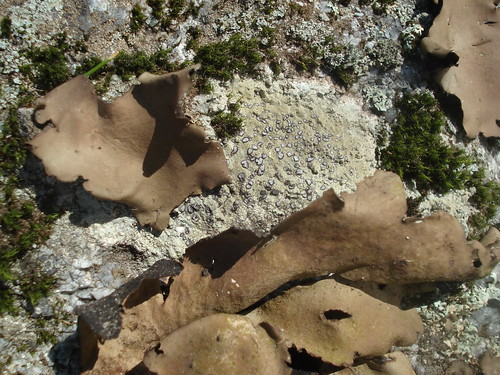
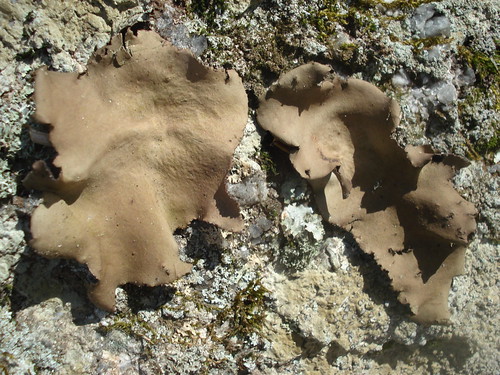
rock tripe, Umbilicaria mammulataAnd Seton's favorite wild edible at this famine time of year? Rock tripe. Which tells you something about the availability of wild foods in winter. I've never eaten tripe (cow intestines), so I'll have to leave it to others to say whether it's an apt description. But I suspect this cardboardy lichen got its common name because it's pretty low on the food totem pole. Rock tripe, Seton wrote, "is not delicious food, nor is it highly nutritious, but it will sustain life, and every traveler should know what it is like and how to use it."

Rock tripe grows in ragged pieces that people describe as looking like lettuce leaves or dried orange peels. They can grow up to 8 inches across, but most are probably in the 2 to 4 inch range. Each piece is anchored to the rock at a small spot in the middle, giving the lichen its Latin name: Umbilicaria. The top can vary in color from brown to grey, and the underside is darker -- often black. You'll often see it growing in clusters, covering the surface of a large boulder. Keep an eye out when you're walking in a rocky place, like the parks along the Potomac.

To me, the most interesting thing about rock tripe is the fact that it is not actually one organism, but two. Lichens, as you may recall from biology class, consist of a fungus living in a symbiotic relationship with algae. Or, as lichenologist Trevor Goward puts it, "lichens are fungi that have discovered agriculture." The fungus provides a structure that retains water and captures minerals; the algae photosynthesizes to provide sugars that are also food for the fungus. Together, they can colonize areas where neither fungi nor algae would otherwise survive.

Unlike most mushrooms and plants, lrock tripe, Umbilicaria mammulataichens persist year-round. And, rock tripe has been shown to contain one-third more calories than equal amounts of honey or corn flakes. Perhaps this is why rock tripe has been eaten for centuries, at least as a survival food. The Cree apparently included it regularly in soups as a thickener; other Native American tribes used it as a food of last resort. And it was from the tribes that European settlers learned the value of this strange food. Washington's troops are said to have used it to help them survive the winter at Valley Forge.

Should you eat rock tripe? We've been known to nibble on a piece now and then, just because we can. We just break a small piece off and chew (and chew, and chew). Folks who've had more experience with the stuff say that if you're going to eat a lot, it's best to dry it, then boil it for about an hour, which will soften it up considerably.  As with all wild foods, check your identification and be sure of what you're working with. And, start with a small quantity until you have a sense of how your body is going to react.

Here's hoping you're never in a situation when you're eating rock tripe out of anything more than curiosity. 

Photo credit: Paul J. Morris; click on photos to go to their pages on Flickr.

Thursday, September 10, 2009

LOOK FOR: Chicken of the Woods

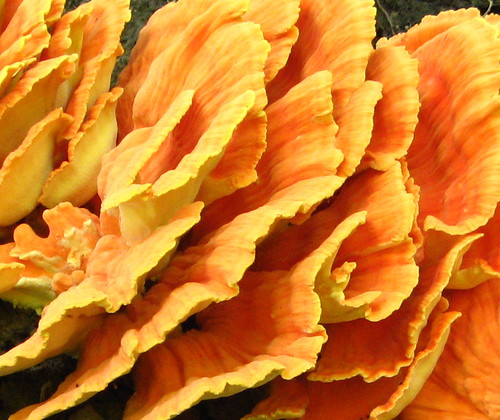
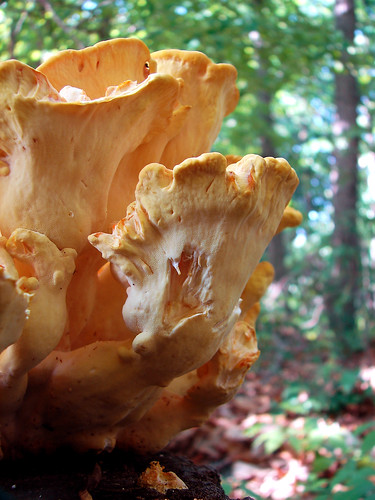
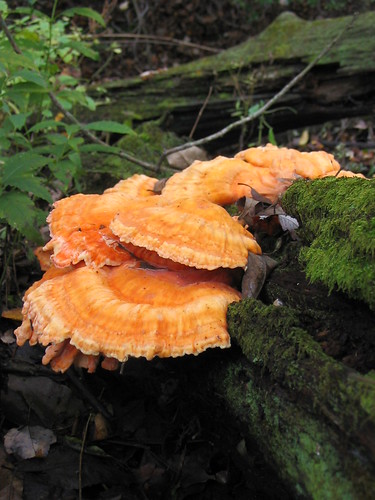
Chicken of the woods is a great mushroom with a great name. The fungus forms overlapping orange fans that look a little like the tailfeathers of a chicken. And if you cook it and eat it (only after careful ID, please!) you may find the texture a lot like chicken, too.

Before the tree leaves start to change, there isn't much orange in the woods. So chicken of the woods (also known as sulfur shelf, or Laetiporus sulphureus, literally "bright-pored sulphur-yellow") can be eye-catching even from quite a distance. There are actually two varieties. One is bright orange on top, with bright sulphur-yellow underneath. It always grows on tree trunks (standing or fallen). The other is a paler orange on top, and nearly white on the underside. It often grows from tree roots. Both have tiny pores on the underside, rather than the gills you see on grocery store mushrooms.

Chicken of the woods is fairly difficult to confuse with other mushroom species once you know what you're looking for. Still, if you want to eat the mushrooms you find, we highly recommend a foray with the Mycological Association of Washington. If you can't make it out with the group, get yourself a couple of ID books to cross-check your identification. And, even once you're sure you've got the right fungus, start out by eating only a little bit and see how it sits with you. For a small percentage of people, chicken of the woods can cause stomach upset.

In the wild: As the name suggests, look in the woods -- although we've seen a few specimens of the root-growing variety coming up in suburban yards, we've found far more of the tree-growing variety in the woods. If you find some, check back again next year in the same spot -- they can come back several years in a row.

In your yard: Although there are companies that sell mushroom kits, we haven't seen this species for sale yet. You'll just have to go for a walk in the woods!

Like the photos in this post? Mouse over for credits; a click takes you to the photographer on Flickr.

Thursday, July 9, 2009

LOOK FOR: Chantarelles

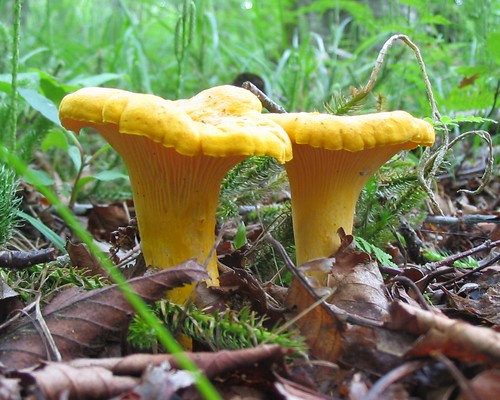
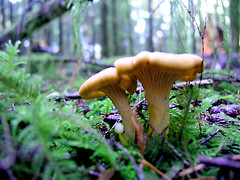
Chantarelles are a choice culinary mushroom prized by chefs around the world. And they grow in Washington, DC.

The most common chantarelle species in our area, Cantharellus cibarius, generally comes up in July; we've already found several this year. They are golden yellow to yellow-orange (but not pumpkin orange). The gills on the underside of the cap are very distinctive because they continue down the stem, and are not very deep -- it's almost like the mushroom has wrinkles, rather than the gills you'd see on a typical gilled mushroom. The smell is also distinctive -- sweet and fruity, like apricots (some guidebooks also suggest rose and pumpkin).

If you're not already a mushroomer, the safest and most productive way to look for wild mushrooms is to go with people who already know what they're doing. Luckily, we have in this area the Mycological Association of Washington, which organizes forays led by people who have an encyclopedic knowledge of our local fungi. They'll generally schedule hunting expeditions in areas where they've had luck in the past, and will identify any mushrooms found on the hike. Even more luckily, there's a foray this Saturday at Lake Bernard Frank.

If you prefer to go on your own, please, please, please get ahold of a couple of mushroom id books and carefully check anything you pick before you eat it. Also, wild mushrooms should always be cooked before you eat them, and never eat anything that looks bug-ridden or rotten, no matter how tempting. For example, chanterelles often have very buggy stems -- cut that part out and just eat the healthy parts. Many cases of "mushroom" poisoning are actually attributable to eating mushrooms that are past their prime.

In the wild: We have seen chantarelles in both Rock Creek Park and Greenbelt Park, sometimes growing right in a trail. (Of course, we should remind you, it is illegal to remove mushrooms from a National Park.) If you find a good spot, check back every year -- the mycelium (something like fungus roots) stay in the same place and produce new fruits (the mushrooms) every year.

In your yard: Not unless you live in undisturbed woods and are really lucky. No one has figured out how to cultivate chantarelles yet. That's what makes it so special to find them in the wild!

Have you found any chantarelles yet this year? Have any good recipes? Let us know -- even if you're not willing to tell us your spot!

Wednesday, May 27, 2009

Fungus Among Us

Science writer Natalie Angier has an article in the New York Times this week exploring the role of fungi, as she puts it, From Killer to Dinner Companion. "Fungi are everywhere," she writes, "on every continent and in every sea, floating in the air, lacing through the soil, resting on your skin, colonizing mucosal cavities within, and festively decorating that long-neglected peach." She touches on chestnut blight, the white-nose syndrome that's killing bats, and athlete's foot, but also on the role of fungi in supporting plants (possibly as many as 90 percent of plant species depend on mycorrhizal fungi to obtain nutrients from the soil) and humans (in the form of yeast for making bread and alcohol). It's a quick and enjoyable read.