
Showing posts with label Plants - September. Show all posts

Thursday, October 22, 2009

LOOK FOR: Wild Grapes

I had a book of Aesop's Fables as a child, and the story I remember best is the story of the Fox and the Grapes. There's a big, juicy bunch of grapes hanging from a vine, and a fox is trying as hard as he can to get to them, but just can't quite reach. When he gives up, the fox says, "I don't want those grapes anyway -- they're probably sour!"

Sounds like the wild grapes of ancient Greece weren't too different from our own -- very tempting but very sour. Our native grapes are also very small. But we like them anyway...and like the fox in Aesop's fable, we'll go to some lengths to get some every fall.

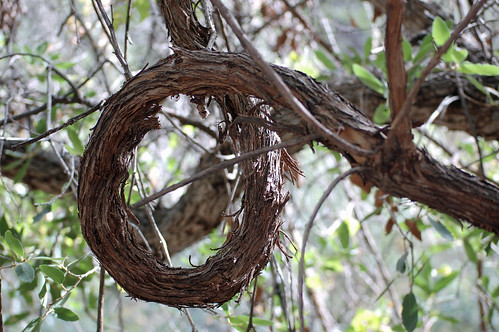
Before you try to eat wild grapes, be confident in your identification. The leaves can be quite varied in size and shape, but generally have roughly toothed edges. The leaves may have three distinct lobes, or they may just hint at them. The vines climb with distinctive, curly tendrils that wrap around whatever they can for support. As they get older, the vines shed their bark, giving them a shredded texture. It's not uncommon to see thick, peeling grapevines reaching far up into the canopy -- they've kept pace with the tree they're hanging from, making sure they can get sun for their leaves even as the tree puts on new growth.
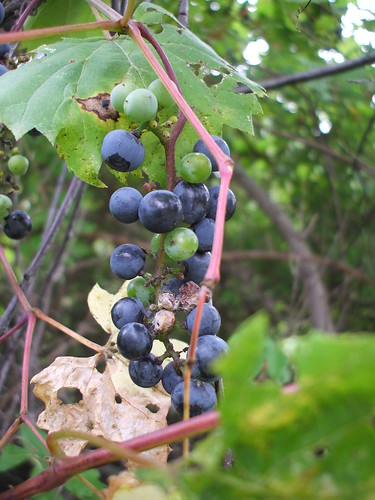
But you're looking for fruit that's within reach, which will likely be on younger vines. Clusters of wild grapes look something like miniature clusters of cultivated grapes. When ripe, they are dark purple, but (like cultivated grapes) they may have a blush of yeast on them that makes them look a little lighter. They have multiple crunchy seeds which take up a lot of the fruit. But the fruit that is there has an intense flavor.

There are several other small, purple fruits in the fall. Make sure you rule these out -- none of them are edible, and some are quite poisonous: virginia creeper (which has leaves made of five leaflets, and red stems on the fruit), Canada moonseed (whose leaves are a similar shape to grapes, but smooth, not toothed; each fruit has a single, moon-shaped seed), porcelain berry (also has grape-like leaves, but the berries are blue and white before ripening, not green like unripe grapes), and pokeweed (not a vine, but it can be mixed into thickets that also include grapes; fruits branch off a very straight stalk that's often reddish).

Enough warnings. We've taught 3-year-olds to reliably recognize wild grapes...you can do it too.
In the wild: Wild grapes need some sunlight to fruit well but they also like the support of trees. They generally thrive where there has been a disturbance in the forest canopy, or on the trees on the edge of a forest. There are tons of grapes out there that you have no hope of reaching, but every once in a while, a younger vine will have some fruit low enough for you to get a taste.

In your yard: Wild grapes are a lot easier to grow than cultivated grapes, in the sense that they don't get as many pests and diseases. But the vines can grow up to 75 feet long. They'll do best in full sun, on a trellis. You can also try a more naturalistic planting, as long as there's something for the tendrils to wrap around for support.

Like the photos in this post? Mouse over for credits; a click takes you to the photographer on Flickr.

Thursday, October 15, 2009

LOOK FOR: Acorns of many shapes and sizes - an identification guide for 12 common oak species

There are 90 species of oak in North America. Their acorns are an important food for a broad diversity of wildlife, from insects to deer. And historically, they were a staple food for Native Americans in this area.

Oaks are generally split into two groups: "red" and "white." Red oaks have leaves whose lobes come to a point, with a little bristle on each point. Their acorns take two years to mature, so even as they're dropping this year's crop, they've already got half-grown acorns for next year. White oaks have leaves with more rounded lobes, typically lighter-colored bark, and their acorns take only one year to mature. But even within those two groups, there's a wonderful diversity of acorn shapes and sizes. Below are a selection of some of the acorns you might see in the greater DC area. (We've tried to line them up so they're to scale.) How many can you find in the wild?

Red Oaks


Northern Red Oak
Quercus rubra
Southern red oak
Quercus falcata
Black oak
Quercus velutina


Willow Oak
Quercus phellos
Pin oak
Quercus palustris
Blackjack oak
Quercus marilandica

White Oaks


White oak
Quercus alba
Overcup oak
Quercus lyrata
Swamp white oak
Quercus bicolor


Chestnut oak
Quercus prinus
Post oak
Quercus stellata
Bur oak
Quercus macrocarpa

One way to really get familiar with acorns is to collect them for Growing Native. The Potomac Conservancy will use them to replant buffer zones along the Potomac and its tributaries. This improves water quality and provides important wildlife habitat. You can donate collected acorns until October 26 in Virginia and October 31 in  Maryland and DC.

All photos by Steve Hurst at the amazing USDA-NRCS PLANTS Database, except the post oak acorns, which are from the magnificent old tree here at The Natural Capital headquarters.

Thursday, October 1, 2009

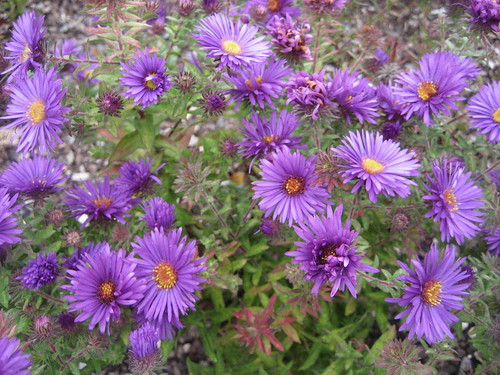
LOOK FOR: New England Asters

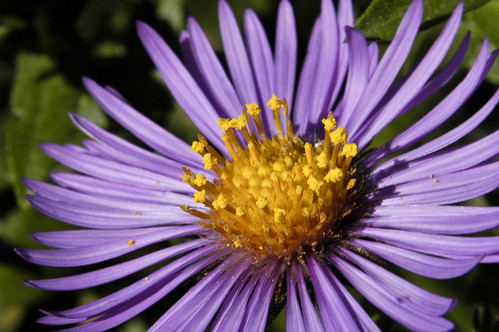
Asters are star-like flowers that bloom in late summer and fall. In the middle of each flower, if you look closely, you will see that the center is actually made up of numerous small flowers, each with its own reproductive parts. Thus, asters are part of the large family of wildflowers known as composites. The many "rays" around the outside of each flower are actually mini-flowers, as well. These rays may or may not have reproductive parts, depending on the species of flower; their main purpose is to draw in the pollinators. And as a side effect, they catch our attention, too.

New England aster is perhaps the showiest of the dozens of native asters in this area. It has bright purple flowers with yellow centers, and it grows at least three feet high -- sometimes as high as six feet. Each flower is about an inch across, and each plant can make dozens of flowers.

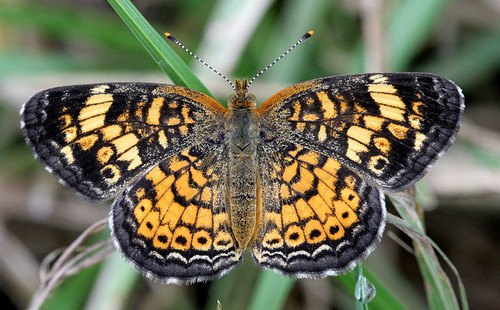
This plant is not only beautiful, but also very useful for wildlife.The pearl crescent butterfly uses New England aster as its host plant, feeding on the foliage.  The flowers provide late-season nectar to a wide variety of pollinators. And the seeds are eaten by finches and other birds.

In the 1990s, DNA testing determined that all of the similar-looking "asters" actually are not as closely related as everyone had thought. Only one of the over 150 species that we call aster in North America is still in the genus Aster, which is mostly made of European species. The rest of our "asters" were split into several genera in 1994. And so, New England aster, which was once Aster novae-angliae, is now Symphyotrichum novae-angliae. Say that ten times fast. Or, forget about saying it and just enjoy the flowers.

In the wild: New England aster requires a fair amount of sun. Look in power line cuts, in meadows, and by ponds. Try the power line cut through Cabin John  Regional Park, the meadow at the Arboretum, the ponds at Meadowside Nature Center and Wheaton Regional Park, and Lake Artemesia.

In your yard: New England aster can be a great addition to a flower garden, because not much else is blooming right now. In fact, Jack Sanders reports that in a poll of hundred of naturalists and  botanists in the 1940s, New England aster came in as the third most popular flower in North America. Nurseries now commonly sell a dwarf form, Purple Dome, if you don't want the tall wild form. Although they may be labeled as a full sun plant, in our experience they do best with some partial shade.The lower leaves can get pretty raggedy, so it's best to plant a shorter plant in front of your asters to shield that part from view.

Like the photos in this post? Mouse over for credits; a click takes you to the photographer on Flickr.

Thursday, September 24, 2009

LOOK FOR: Spicebush Berries

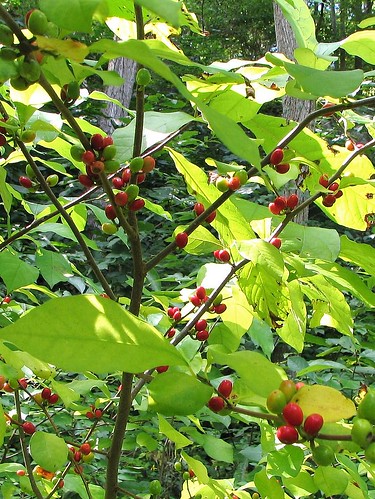
If you have ever been hiking in the woods in the DC area, chances are you've walked by hundreds of spicebush shrubs. They've got small yellow flowers in the spring, then they form a nondescript green backdrop in the woods for the rest of the summer. Until September -- when their berries turn bright red.

Spicebush can grow up to 20 feet tall, but we commonly see them at about 5-10 feet. The leaves have smooth edges and alternate along the branch. As fall progresses, the leaves will turn yellow.  The berries may remain on the shrub after the leaves have fallen off, but the birds may get to them first.

The twigs, leaves, and berries of spicebush all have a smell reminiscent of nutmeg or allspice when crushed.  Presumably, the Latin name Lindera benzoin was given as a reference to benzoin resin, which was used to make incense and perfume in Asia and Europe.  It's actually more related to laurels, including the bay laurel that gives us bay leaves.

Spicebush parts don't just smell good -- you can use them as a spice. The twigs can be brewed in hot water to make tea. Berries can be used fresh or frozen, as an allspice substitute. (Steve Brill recommends against drying.) We'll often cook them up with sliced apples to make a delicious topping for pancakes. Each berry has a single seed inside, which can be ground up with the rest if you're going to use it as a spice -- that's a lot less work than trying to get the seed out of each one. 

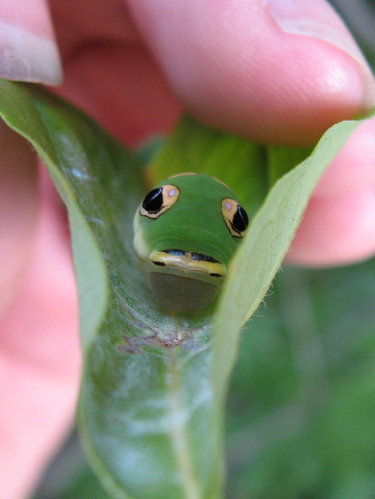
As you're looking for the berries, also take a peek if you see any leaves folded over. You might find the caterpillar of a spicebush swallowtail butterfly, whose only host plant is the spicebush. They're lovely black butterflies, but their caterpillars are adorable -- they have big eyespots that make them look like a cartoon snake. You might also find the caterpillar of a promethea silkmoth, a large and beautiful moth that we have seen far more as a cocoon hanging from spicebush than in any other stage of its life cycle.

In the wild: Spicebush is one of the dominant understory shrubs in our local forest.  In Rock Creek Park, we recently noticed large groves on both sides of the Valley Trail, in the section east of Boundary Bridge.

In your yard: Spicebush need shade, but a few hours of sun will encourage them to flower more and set more fruit. They can also suffer if they get too dry, especially as they're getting established -- they'll do best with reasonably moist soil.

Like the photos in this post? Mouse over for credits; a click takes you to the photographer on Flickr.

Thursday, September 17, 2009

LOOK FOR: Paw Paws

The paw paw is the largest fruit of any native plant in our area. And you can eat it. And they should be ripening over the next few weeks. Need I say more?

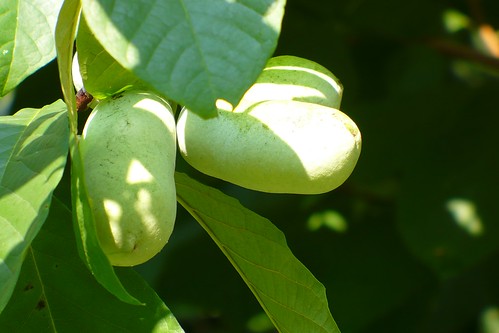
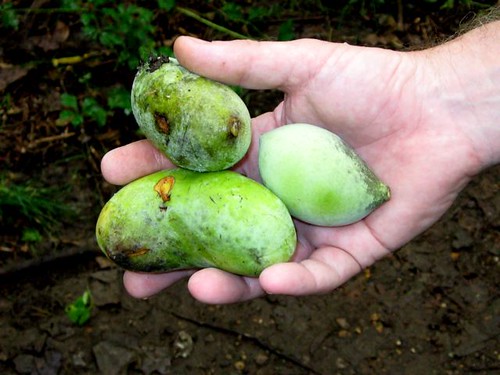
Paw paw fruits have a green skin and soft yellow flesh, and are typically about the size of two golf balls stacked together. The flavor has been described as similar to many different things -- banana, custard, mango -- but really it has its own taste. Pawpaws can have an unusual aftertaste that limit me to enjoying one or two fruits. But those few fruits are such a treat when they come from the forest!

Paw Paw (Asimina triloba) is the northernmost member of the Annonaceae family, which includes other tropical fruits such as the soursop. I had always thought they were related to papaya, but apparently it is in name (and somewhat appearance) only.

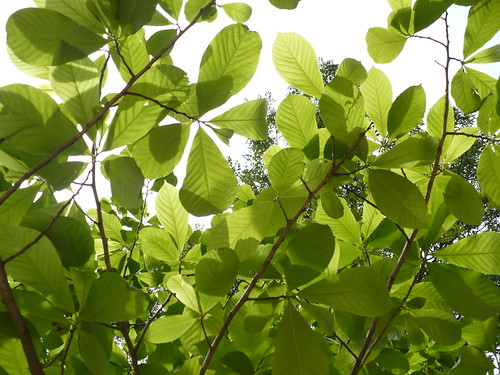
Immature paw paw trees are abundant in the forests in and around Washington, DC. When young, they look more like an understory shrub than a fruit-bearing tree. You will often see groves of them growing together, because they can spread by underground roots. Their large, broad leaves (6 to 12 inches long) alternate along the branches and have a distinctive smell when they are rubbed or broken. (It reminds me of kerosene.)

It seems only a small fraction of the abundant small trees actually become large enough to bear fruit. They also fruit more when the trees that allowed them to thrive as shade-loving seedlings die and fall, leaving the pawpaws with more sun. Under the right conditions, they can bear quite a crop. Paw paws attract not only humans but are also a good food source for racoons, opossums, and squirrels. (As an added bonus, the leaves of the paw paw tree are the larval food of beautiful zebra swallowtail butterflies.)

For harvesting, you want the fruit to be quite soft; the best way to find ripe fruits is to shake the tree and go after the ones that fall down. The skin will be green even when ripe.

In the wild: We seem to find the most large, fruit bearing trees along the Potomac flood plain. Look for breaks in the tree canopy where pawpaws may be getting more sun. We've seen numerous fruits recently (not yet ripe) on trees in the Carderock area and at Scott's Run...and even a few in Rock Creek Park.

In your yard: Pawpaws were once cultivated by Native Americans, and Thomas Jefferson is said to have planted them at Monticello - so you'd be in good company if you want to try to grow one. They're supposed to be easy to start from seed. You might have the best luck with seed collected from racoon or opossum scat. However, that presages a challenge to getting the fruit from your trees -- the raccoons may beat you to them.

Like the photos in this post? Mouse over for credits; a click takes you to the photographer on Flickr.