Showing posts with label Plants. Show all posts

Thursday, October 8, 2009

LOOK FOR: Bright Red Virginia Creeper

Virginia Creeper is one of the first signs of fall in the DC area. You should notice its leaves (each made of five leaflets, in a palmate form, alternating up the vine) turning red soon.

The scientific name for Virginia Creeper, Parthenocissus quinquefolia, literally means "five-leaved virgin-ivy." (Perhaps starting the name with partheno, or virgin, was an old-school pun on the plant's common name.) Some people call it five-leaved ivy, though it's in a different family from the other "ivies" we know, and certainly won't make you itch like poison ivy (which, you'll remember, has three leaves).

But Virginia creeper and poison ivy do share the characteristic of turning red early in the fall. Most plants turn color simply because they're giving up on photosynthesis for the year, and they're losing the chlorophyll that turns their leaves green. But these vines have evolved to turn red a little earlier than they really need to. It turns out that they're colorful around the time that their berries are ripe, which serves as a loud announcement to birds to come and check them out. The extra advantage in seed spreading must be worth trading off for the extra bit of energy the plants might gain by photosynthesizing for a little longer.

In the wild: Virginia creeper grows throughout the DC metro area, and can live in many different environments -- sunny and shady, wet and dry. If you learn to spot it this fall while it's red, perhaps you'll it notice next year while it's green.

In your yard: Virginia creeper is considered fairly aggressive -- it can take over an area if you don't stay on top of it. But this characteristic can make it a good solution for an area that needs covering -- an ugly fence, a wall, or as William Cullina suggests, "an old rusty Chevy out in the yard that is becoming an eyesore."

Like the photos in this post? Mouse over for credits; a click takes you to the photographer on Flickr.

Thursday, September 24, 2009

LOOK FOR: Spicebush Berries

If you have ever been hiking in the woods in the DC area, chances are you've walked by hundreds of spicebush shrubs. They've got small yellow flowers in the spring, then they form a nondescript green backdrop in the woods for the rest of the summer. Until September -- when their berries turn bright red.

Spicebush can grow up to 20 feet tall, but we commonly see them at about 5-10 feet. The leaves have smooth edges and alternate along the branch. As fall progresses, the leaves will turn yellow.  The berries may remain on the shrub after the leaves have fallen off, but the birds may get to them first.

The twigs, leaves, and berries of spicebush all have a smell reminiscent of nutmeg or allspice when crushed.  Presumably, the Latin name Lindera benzoin was given as a reference to benzoin resin, which was used to make incense and perfume in Asia and Europe.  It's actually more related to laurels, including the bay laurel that gives us bay leaves.

Spicebush parts don't just smell good -- you can use them as a spice. The twigs can be brewed in hot water to make tea. Berries can be used fresh or frozen, as an allspice substitute. (Steve Brill recommends against drying.) We'll often cook them up with sliced apples to make a delicious topping for pancakes. Each berry has a single seed inside, which can be ground up with the rest if you're going to use it as a spice -- that's a lot less work than trying to get the seed out of each one. 

As you're looking for the berries, also take a peek if you see any leaves folded over. You might find the caterpillar of a spicebush swallowtail butterfly, whose only host plant is the spicebush. They're lovely black butterflies, but their caterpillars are adorable -- they have big eyespots that make them look like a cartoon snake. You might also find the caterpillar of a promethea silkmoth, a large and beautiful moth that we have seen far more as a cocoon hanging from spicebush than in any other stage of its life cycle.

In the wild: Spicebush is one of the dominant understory shrubs in our local forest.  In Rock Creek Park, we recently noticed large groves on both sides of the Valley Trail, in the section east of Boundary Bridge.

In your yard: Spicebush need shade, but a few hours of sun will encourage them to flower more and set more fruit. They can also suffer if they get too dry, especially as they're getting established -- they'll do best with reasonably moist soil.

Like the photos in this post? Mouse over for credits; a click takes you to the photographer on Flickr.

Thursday, September 17, 2009

LOOK FOR: Paw Paws

The paw paw is the largest fruit of any native plant in our area. And you can eat it. And they should be ripening over the next few weeks. Need I say more?

Paw paw fruits have a green skin and soft yellow flesh, and are typically about the size of two golf balls stacked together. The flavor has been described as similar to many different things -- banana, custard, mango -- but really it has its own taste. Pawpaws can have an unusual aftertaste that limit me to enjoying one or two fruits. But those few fruits are such a treat when they come from the forest!

Paw Paw (Asimina triloba) is the northernmost member of the Annonaceae family, which includes other tropical fruits such as the soursop. I had always thought they were related to papaya, but apparently it is in name (and somewhat appearance) only.

Immature paw paw trees are abundant in the forests in and around Washington, DC. When young, they look more like an understory shrub than a fruit-bearing tree. You will often see groves of them growing together, because they can spread by underground roots. Their large, broad leaves (6 to 12 inches long) alternate along the branches and have a distinctive smell when they are rubbed or broken. (It reminds me of kerosene.)

It seems only a small fraction of the abundant small trees actually become large enough to bear fruit. They also fruit more when the trees that allowed them to thrive as shade-loving seedlings die and fall, leaving the pawpaws with more sun. Under the right conditions, they can bear quite a crop. Paw paws attract not only humans but are also a good food source for racoons, opossums, and squirrels. (As an added bonus, the leaves of the paw paw tree are the larval food of beautiful zebra swallowtail butterflies.)

For harvesting, you want the fruit to be quite soft; the best way to find ripe fruits is to shake the tree and go after the ones that fall down. The skin will be green even when ripe.

In the wild: We seem to find the most large, fruit bearing trees along the Potomac flood plain. Look for breaks in the tree canopy where pawpaws may be getting more sun. We've seen numerous fruits recently (not yet ripe) on trees in the Carderock area and at Scott's Run...and even a few in Rock Creek Park.

In your yard: Pawpaws were once cultivated by Native Americans, and Thomas Jefferson is said to have planted them at Monticello - so you'd be in good company if you want to try to grow one. They're supposed to be easy to start from seed. You might have the best luck with seed collected from racoon or opossum scat. However, that presages a challenge to getting the fruit from your trees -- the raccoons may beat you to them.

Like the photos in this post? Mouse over for credits; a click takes you to the photographer on Flickr.

Thursday, August 20, 2009

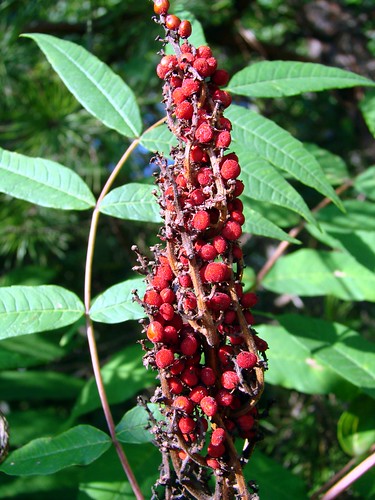
LOOK FOR: Sumac Berries

Lemonade is a major staple in our household over the summer months. For a special treat, we make lemonade without lemon juice -- we brew it from lemony sumac berries.

There are actually several varieties of sumac in our area. All get extremely distinctive clusters of dark red, hairy berries in the late summer. And they all have pinnate leaves (multiple leaflets on a stem form the larger leaf) that turn gorgeous shades of red to purple in the fall.

Rhus typhina, staghorn sumac, is the giant of the genus, growing up to 25 feet tall. It has fuzz on the stems very much like the fuzz that covers new antlers on a deer. Rhus coppalina, shining or winged sumac, has "wings" on its stems; Rhus glabra, or smooth sumac, has smooth (not winged or fuzzy) stems. And the distinguishing characteristic of Rhus aromatica, or fragrant sumac? Its leaves have a distinctive odor when crushed.

Worried about poison sumac? It's actually an unrelated shrub (Toxicodendron vernix) that is not very common in the DC area. Its berries are white, so it is not likely that you will confuse it with non-poison sumac if you are out looking for red berries. But you're right to worry -- it will give you a rash, just like its much closer relative poison ivy (Toxicodendrum radicans).

To make sumac lemonade, cut off a few heads of berries with some garden clippers. Soak them in a half-gallon of water for half an hour or more. This will leach out the ascorbic acid (Vitamin C) and its lemony flavor, along with enough color to give you pink lemonade. You can crush the berries a little with your hands to help the process along. There's a sweet spot you're looking for -- too little soaking won't give enough flavor, but too much will start to leach out the tannins and make your lemonade taste more like tea. Pour the liquid through a strainer to get out the hairs, then sweeten to taste.

There's one catch: just like the lemony goodness of the sumac berries will leach out into your pitcher of water, it will leach out in the rain. So you may find lovely bunches of sumac berries that have very little flavor. Before picking, take a little taste test of one of the berries. It should be noticeably tart. If not, look for another bunch -- preferably one that's been more sheltered from the rain.

In the wild: Sumac is very common in the DC area. We see it most frequently on roadsides -- it likes the sun. All four varieties of sumac native to our area are growing around Lake Artemesia -- take an ID book and see if you can find each species! The berries are good food for birds, so please don't take too many heads of sumac, and be sure to use whatever you do pick. Also be sure not to pick in a park that doesn't allow it.

In your yard: Sumac has a reputation for being very aggressive -- it spreads by underground roots and can take over an area. Which makes it great for roadsides, but not so much in your yard -- unless you have a lot of space.

Like the photos in this post? Mouse over for credits; a click takes you to the photographer on Flickr.

Thursday, July 30, 2009

LOOK FOR: Jewelweed

Jewelweed is a pretty flower, a sparkly wonder, a trailside snack, and a soothing skin treatment. What's not to love?

There are actually two species of jewelweed in our area: Impatiens biflora, which has darker orange flowers, often in pairs, and Impatiens pallida, with paler yellow flowers. Both have darker orange or red spots. And yes, they are relatives of the common garden impatiens (the genus includes hundreds of species) -- but unlike the impatiens in my mom's yard, jewelweed can grow 3-5 feet tall.

Water beads up on the dusky-colored leaves of jewelweed, creating sparkling jewels after a rain. According to Steve Brill, they also look beautiful underwater: the undersides of the leaves will turn silvery.

The flowers and seeds of jewelweed are edible. But you'll have to be careful to collect any seeds. Another common name for jewelweed is "touch-me-not": the seedpods will explode when you touch them. Of course, this is fun in itself -- but if you surround the seedpod with your whole hand and squeeze, it should explode in your hand, and you can try the nutty little seeds.

Jewelweed also provides food for wildlife: the bright, trumpet-shaped flowers can attract hummingbirds and butterflies. If you sit by a patch for a little while, you're sure to at least see bees crawling inside the flowers for the nectar.

The flowers and seeds are just a little nibble for us humans. But jewelweed has been highly valued for centuries as a treatment for skin irritation. It turns out that it includes one of the active components of Preparation H. No special preparation is necessary -- just break a stem or crush up several leaves, and rub the juice on the irritated area.

I have to admit, I have been something of a jewelweed doubter. It is said to soothe bee and wasp stings and mosquito bites -- though of course it's still more comforable to not get stung or bitten in the first place. I never could tell much of a difference after rubbing it on mosquito bites. But recently, I brushed against some stinging nettle, and immediately rubbed the sting with jewelweed. I do think the pain stopped much more quickly than in my previous stinging nettle encounters. The two plants often grow side-by-side: both like moist areas.

Jewelweed is also said to prevent a poison ivy rash, if you rub the area that has been exposed to poison ivy with jewelweed juices soon after exposure. Steve Brill also claims it can be used to soothe warts, bruises, fungal infections, burns, cuts, eczema, acne, and any other skin irritations; his website describes how to make a tincture or ointment to keep at home.

In the wild: Jewelweed is common in this area along streams and in wet areas, typically in partly shady areas.

In your yard: If you have a moist spot, you could try growing some. Jewelweed is said to be easy to start from seed (but we've never tried).

Like the photos in this post? Mouse over for credits; a click takes you to the photographer on Flickr.

Tuesday, July 28, 2009

Bookshelf: Wildflower ID

If there's one book we take on walks with us more often than any other, it's a wildflower ID book. After 9 years or so of doing this, the woods are no longer just a big mass of green -- each plant is like an old friend that we're checking in with. When we see something unusual, it jumps out at us. And out comes the ID book.

There are three popular books that cover the flowers of this region well: Newcomb's, Peterson's, and Audubon. Your preference will likely depend on which one you start using first. After learning the Newcomb's system, for example, we find it tedious to ID plants in Peterson's. But we've heard the opposite from folks who started out with Peterson's. And when we recently tested all three books with a couple of Natural Capital readers who happened to be hanging out on our porch, Audubon was a clear favorite. Here's a description of the three books and how they work.

Newcomb's Wildflower Guide (1375 species, 490 pages, some color and some black and white illustrations). The key to Newcomb's ID system is a key: a method of identifying certain characteristics about a plant to help you find it quickly in the book. This requires you to look closely at your plant. First, three questions: 1) the type and number of petals, 2) the position of the leaves, and 3) the basic leaf shape. You're then referred to a page with additional questions specific to the set of plants that you could be looking at. As people who really wanted to learn a lot of plants, we found that the investment in learning this ID system was worth it -- we can find most plants much more quickly with the key than by flipping through other guides, and the hands-on attention required to use the ID helps us get to know the plant. To our porch-based test group, however, the key was completely baffling.

Peterson: A Field Guide to Wildflowers (1293 species, 420 pages, color and black and white illustrations). In the introduction to this field guide, Roger Tory Peterson writes, "if one can master them, keys are the proper formal approach to flower identification. But, I am afraid, most of us belong to the picture-matching school, and it is for this audience our Field Guide has been planned." The flowers are organized first by color. At the beginning of each color section, there are some pages with representative types of flowers, to help you narrow your search. The rest of each section includes black-and-white drawings of many more species, organized by flower shape. As with Newcomb's, descriptions of the species pictured are on each facing page. Our testers' main complaint was that the black-and-white drawings made it more difficult to envision whether the drawing was a good match for the plant they were trying to identify.

National Audubon Society Field Guide to North American Wildflowers (658 species, 888 pages, color photographs). Audubon covers half as many species as the other two books, in twice as many pages. With large photographs, only 2 to 3 flowers fit on a page. The species descriptions are also longer; they are in a separate section of the book, which requires some flipping back and forth. Like Peterson's guide, Audubon organizes flowers first by color, then by flower type. The color photographs were a big hit with our testers. And Matt identified a few plants via photographs in here that had been eluding him in the Newcomb's key. As with the bird books we reviewed, however, using photographs can have drawbacks. When a photo is good, you know immediately that you've found the right plant (or a close relative). But for some plants, the photos are limited by focusing only on the flowers; there may be clues in the foliage that are not well illustrated.

The bottom line: The Audubon book seems to be the most appealing to beginners. The photos are nice enough that you may find yourself just browsing through the book, which is a great way to prime yourself to recognize things in the field. But if you want more depth, you may find a book like Newcomb's might also be rewarding, with its much larger coverage of species.

If you want to buy: We got the wildflower books we didn't own from the library to evaluate them, and encourage you to do the same. But if you're ready to buy one, consider supporting The Natural Capital by going through the links in this post -- or use this little store we set up to mirror our own bookshelf of nature books. We'll get a tiny cut off anything you buy there. We also thought it would be a help to Natural Capital readers to set up that virtual bookshelf just so folks could see which books we've found useful. Of course, you're free to buy any of them wherever you like!

Thursday, July 23, 2009

LOOK FOR: Cardinal Flowers (and Hummingbirds)

I used to love cardinal flower just because it's a gorgeous flower. It took a few years before I realized that if you sit quietly for long enough by a large patch, a hummingbird will come by. And that takes it to another level.

Lobelia cardinalis has brilliant, deep red flowers. In his book Wildflowers: A Guide to Growing and Propagating Native Flowers of North America, William Cullina describes them like this:

It is as if the flowers catch sunlight inside some sort of secret crystal matrix and let it bounce around for a while until it has been stripped of all but the deepest, purest red imaginable. Then and only then is the light released to burn crimson into our corneas.I will never forget the first time I found one in the wild, just a single plant growing in a low area behind my house. I stood there stunned for about five minutes trying to fathom how such a magical thing had come there.

Chances are, if he stood longer than five minutes, Cullina saw other magical things. The flowers don't have much of a smell. But that brilliant red is mightily attractive not just to humans, but to hummingbirds and butterflies -- especially, I've noticed, to eastern black swallowtail butterflies. If you find a patch, sit a while and see who comes by. Nothing is ever foolproof, but almost every time I have tried it, I have seen one or the other within twenty minutes. Just last week, a hummingbird started coming regularly last week to the patch of cardinal flowers in our yard, for the third year in a row.

Cardinal flowers bloom in a long spike at the top of a stem that can grow up to 4 feet tall. The flowers are worth a close look: they're quite unusual. Plants in the genus Lobelia all have similar asymmetrical tubular flowers, with the tube slit along the upper side. The flower's five anthers are united around the style, forming a silvery-lavender point that itself almost glows against the red of the flowers.

In the wild:Cardinal flower loves wet areas; you'll see it growing along streams or ponds. It's not the most common flower, but if you keep an eye out in these areas you should be able to find some.

In your yard: Cardinal flower is a perfect choice for a rain garden that catches water off your roof or any other wet spot in your yard. It can also be planted in normal, non-wet garden soil, especially with more shade -- it won't thrive during a drought, and it may not form as abundant a patch as it would with water, but it should do just fine. It's fairly easy to start from seed -- but be careful, the seeds are tiny!

Do you know a good cardinal flower patch? Any questions or observations? Leave a comment.

Like the photos in this post? Mouse over for credits; a click takes you to the photographer on Flickr.

Thursday, July 16, 2009

LOOK FOR: Wineberries

We're generally opposed to the Asian plants that have made it into our local woods, but the wineberry (Rubus phoenicolasius) might be one exception. For several weeks in July, these relatives of our native raspberries are abundant and delicious. And, if we can get to the berries before the birds do, and keep the plants from spreading, all the better. Get out there and do your part!

You've probably seen wineberries in the woods, but you may not have known what they were. Like other raspberries, wineberries grow on canes that grow up, then arch over to root and start another plant. With this growth habit, they can create large thickets. Unfortunately, their stems are covered in pinkish bristles -- they can give you quite a scratch if you're not careful. All raspberries have leaves of three, but those prickles are a key distinguishing characteristic that will help you tell the difference between wineberries and poison ivy (which has smooth stems). In addition, the undersides of the leaves are much whiter underneath than on top.

But at this time of year, the give-away is the clusters of red berries. They are shiny -- each one is like a collection of little glass balls. Wineberries darken and sweeten as they get riper. In general, though, even when they're very ripe, they're a little tarter than cultivated raspberries. For the sweetest berries, you want the ones that fall right off when you go to pick them, leaving behind the cone-shaped receptacle that they were growing on. Be gentle with them -- they can crush easily.

In the wild: The two most abundant wineberry spots we know of are along the C&O Canal near Chain Bridge, and Seneca Creek State Park in Gaithersburg (Matt will be leading a wild edibles hike there on August 1 -- let's hope the berries are still producing!). But they are scattered throughout other parks as well.

In your yard: Try planting a native raspberry, like the black raspberry, Rubus occidentalis. It ripens a little earlier (ours started in mid-June) and the flavor is sweeter. We love them both, but the blackcaps could use all the help they can get against the invasive wineberries.

Tuesday, July 7, 2009

Bookshelf: Bringing Nature Home

Food writer Michael Pollan has gotten a lot of mileage out of his three-sentence manifesto: "Eat food. Not too much. Mostly plants." If Doug Tallamy had a similar manifesto, it might be this: "Plant native plants. As many as you can. Especially trees."

"As far as wildlife is concerned," Tallamy writes in Bringing Nature Home, "we have shrunk the United States to 1/20 its original size." Worse, the five percent that's left is divided into tiny islands of habitat. Because species loss is typically proportionate to habitat loss, he argues, "When extinction adjusts the number of species to the land area that remains...we will have lost 95% of the species that greeted the Pilgrims." In fact, bird populations have already fallen by 50% since 1966.

In the face of this massive habitat loss, the land preserved as parks is just a drop in the bucket. If we really want to preserve wildlife, we must provide food and shelter in our backyards (and in the shared green spaces of our apartment buildings). And it turns out that what you plant for food really matters.

Plant native plants. Plants have numerous chemical defenses against being eaten. And, over tens of thousands of years, specific insects have evolved the ability to overcome the defenses of specific plants. In fact, 90% of insect herbivores are specialists, relying on just one or a few plants. If you bring in a plant that hasn't grown in this area for tens of thousands of years, chances are, nothing will be able to eat it. This doesn't just matter for the insects, but also for the birds and other critters that rely on insects as their main source of food.

As many as you can. The more diverse and numerous the native plant population, the more numerous and diverse the insect population. And the more numerous and diverse the insect population, the more predators they will attract. That means birds -- and also ladybugs and other predatory insects. In contrast, with less diversity, there may not be a year-round source of food for these animals. And a less-diverse area has less ability to adjust if something goes wrong with a particular plant in a particular year.

Especially trees. Tallamy and his research assistant compiled data on which tree genera support the most wildlife (using butterflies and moths as a proxy). The top five: oak (517 species of butterflies and moths), willow (456 species), cherry and plum (448 species), birch (413 species), and poplar and cottonwood (368 species). But while a single tree can be a tremendous resource for wildlife, it's important to also plant shrubs and perrenials; they'll create even more diversity.

Will my neighbors hate me? No. Native gardens can be just as formal as gardens full of non-native plants. And they'll love the birds and butterflies that you attract to your garden.

Do I have to get rid of my non-native plants? Well, you can start by just adding natives to your existing garden. But consider that your non-native plants may cause habitat loss even in protected areas when they spread their seed by wind or by birds. Our local parks are full of English ivy, Japanese honeysuckle, Japanese barberry, privet, and other non-native plants commonly planted in yards. They are smothering out the natives that wildlife need to survive. (Check here for a list of some of the most problematic invasives in our area.)

Insects? Really?
Throughout the book are some amazing pictures and stories about the insects you might find on native plants. Not just creepy-crawly things, but beautiful butterflies and moths. You can also read about crickets that use the parabolic dish of a leaf to make themselves louder; milkweed bugs that migrate north with the ripening of milkweed seeds; treehoppers that communicate with each other by vibrating twigs; aphids that give birth to live young without a male's involvement; and the origins of Spanish Fly. It's enough to make you want to get out there and take a look. But, first there has to be something to look at. So...plant those native plants. As many as you can. Especially trees.

Thursday, July 2, 2009

LOOK FOR: Common Milkweed

Milkweed is a beautiful, once-common roadside plant that is struggling in modern times. If you love monarch butterflies, you should show milkweed some love. Their lives depend on it: monarch larvae can only survive by eating milkweed leaves.

In June, common milkweed starts to form clusters of green balls -- the flower buds. And later in the month, these buds burst open into showy balls of tubular pink flowers. At 3-6 feet tall, with multiple flower clusters per stalk, this can be a very showy plant. On the few occasions I've come across a really large field of common milkweed, I've been intoxicated by the fragrance and the multitudes of pollinators dancing about. It's a lovely way to spend an afternoon.

There are many species of milkweed in the genus Asclepias. All share the property that when you break a leaf or stem of the plant, a white latex oozes out. (A 3-year-old friend recently tried to explain to me how cows get this "milk" into the milkweed, but I didn't quite follow it all.) Common milkweed, Asclepias syriaca, apparently got its scientific name through a botanical mix-up in the 1600's with a plant from the middle east (thus the Syrian epithet). Actually, this plant is all-American, and widespread east of the Rockies.

But not as widespread as it once was. Development and roadside mowing have dramatically reduced the milkweed available for hungry monarch caterpillars. Though logging in the monarchs' Mexican wintering grounds gets more attention, they also have less and less habitat for raising young here in the north every summer. Some states have started to catch on that by mowing roadsides just once or twice a year in spring and fall, they can save money and help wildlife at the same time. Let's hope this trend spreads.

In addition to supporting monarchs and many other pollinators, common milkweed was a staple plant for many Native Americans. At this time of year, the flower buds (pictured to the right) can be cooked much like broccoli. However, if you are going to eat milkweed, it is important to learn to distinguish it from poisonous dogbane (Apocynum cannabinum, aka indian hemp), which can look similar (same height, milky sap but less of it, similar shaped leaves but smaller). Dogbane has different flowers and no fuzz on the stem or undersides of the leaves as milkweed has. The most important difference is that dogbane is very bitter, while milkweed should taste like a sweet green vegetable. It really is quite good.

In the wild: Milkweed likes the sun -- look around unmowed open fields, power line clearcuts, and roadsides. For those of you around Takoma Park, there's quite a bit growing downhill from the track at Takoma Middle School, making a valiant stand against the invasive kudzu and porcelain berry.

In your yard: Common milkweed isn't recommended for yards because it can spread quite aggressively by underground roots. If you have an area like a street box that is self-contained it might work well there. Otherwise, try a less aggressive species, like swamp milkweed (Ascelpias incarnata) or butterflyweed (Asclepias tuberosa). Monarch larvae can survive on any species of Asclepias, and we've found them on both of these in our yard. Both are beautiful -- and likely to be the subject of future posts!

Thursday, June 25, 2009

LOOK FOR: Ramp Flowers

Ramps are well-known in the Appalachians as a sign of spring. When their broad green leaves emerge in April, there are ramp festivals throughout the region, as people cook up the roots and leaves. A member of the genus Allium, ramps are closely related to garlic and onions -- and are often called wild leeks.

By early June, the leaves have completely disappeared -- they can't photosynthesize much once the trees block their light. But right around now, where the leaves once were, you'll see a single stalk (about 6-8 inches tall) with a pompom of white flowers on top. As they mature, each of the small flower stalks on top will dry and remain in place. In the fall and winter, these dried pompoms stand out even when all other signs of the plant have disappeared -- especially if they still have the shiny black seeds at their tips. (The species name, Allium tricoccum, refers to the three seeds produced by each flower.)

Doug Elliot gives this interesting factoid about ramps in his book Wild Roots:
Because of their strong odor, Ramps were called pikwute sikakushia (the skunk) in the language of the midwestern Menomini Indians. Rich woodlands near the southern end of Lake Michigan were said to be a favorite Ramp gathering area, for which reason they called this area shikako, (the skunk place). This is where the fuming, seething, metropolis, now known as Chicago, gets its name.
Skunky or no, many wild food enthusiasts say ramps are tastier than any cultivated allium.

In the wild: Ramps are associated with the mountains, but they do grow in the wild along the Potomac -- perhaps the seeds have washed downstream. They grow in profusion at Scott's Run. We also have seen them on an island off the C&O Canal.

In your yard: You'll want a shady spot with rich soil. I'm not aware of nurseries that sell them, but you could try collecting seed in the fall and see if you can get them to come up. They will need to be in the cold outdoors over the winter, just like they would be in the wild. And some may take more than a year before they germinate. But it's worth a try!

Ramps

Friday, June 5, 2009

Avoiding Poison Ivy

On most of the hikes we lead, poison ivy is one of the very first plants we point out. And so we have been remiss in not doing the same here. Learn this plant. Do not touch it. It might give you a really miserable rash.

The two rules we learned as kids tell you most of what you need to know:
  • Leaves of three, let them be.
  • Don't be a dope and touch the hairy rope.
Leaves of three: Many people could pick out the plant on the right as poison ivy: leaves of three, sometimes with notches on the sides of the leaves, growing close to the ground. Some exceptions to the leaves-of-three rule: Blackberries and raspberries also have leaves of three, but they have thorns; poison ivy has smooth stems. Box elder (a type of maple) has very similar leaves of three, but each set of three grows directly opposite another set of three; in poison ivy, the leaves alternate down the stem. Confused? Just follow the more general rule: leaves of three, let them be.

The hairy rope: Poison ivy will seek out trees and climb up them. The vines are covered in hairs -- not just on the side of the vine attached to the tree, but all over. The vines can be pencil-thin when young, growing to several inches wide as they age. All of the leaves you see in the picture to the left are poison ivy, not tree leaves. All parts contain the chemical that gives you an itchy rash: the leaves, their stems, and the vine they're growing from. So don't be a dope and touch the hairy rope.

Other forms: Poison ivy can be a shape-shifting, sneaky plant. See, for example, the branch to the right, which was sticking out at least 6 feet from a tree. The entire branch is poison ivy, growing off a vine, not out of the tree trunk. The plants are also strong enough to send up shoots from the ground that can grow to at least 3 feet tall. In these cases, many people assume the poison ivy is a tree or a shrub. It may not be. Repeat after me: leaves of three, let them be.

Avoiding the rash: At this time of year, it's tempting to wear shorts, but you'll be much safer wearing a pair of lightweight pants, especially if you like to go off trail. If you think you might have brushed against poison ivy, wash it off with rubbing alcohol (it breaks up the oils) or soap and cool water. The sooner the better.

More info: Poison-ivy.org
Poison Ivy, Oak and Sumac Information Center

Do you have other tips for recognizing (and avoiding) poison ivy? Please share!

Thursday, June 4, 2009

LOOK FOR: Serviceberries

serviceberry, amelanchier, juneberry
Photo credit: dbarronoss
When people ask us what kind of flowering tree they should plant in their yard, Matt has lots of nuanced answers. I almost always say: a serviceberry. White flowers in the spring, tasty fruits for you and the birds in June, fall foliage, and often a nice multi-stemmed growing habit...what's not to love?

But whether you have a yard or not, now is the time to look for the berries. They're smaller than a typical cultivated blueberry, but they have the same sepals on the bottom. As they ripen, they turn from magenta to a dark purple. Serviceberries were widely used as a food by Native Americans, and George Washington planted several at Mount Vernon. But they don't ship well, so they've never taken off as a commercial fruit.

Serviceberries go by many names, and each name has a story. The story I have heard related to the "service" is that they bloom around the time the ground thaws in the spring, and so were associated with the funeral services that happened when graves could first be dug (other authors say it's a corruption of "sarvisberry," a reference to the European mountain ash). Around the same time of year, shad (a type of saltwater fish) come up rivers to spawn, and so serviceberry is also known as shadbush. The name we first learned for serviceberry was Juneberry; this may be more or less accurate depending on your latitude and elevation. Then there's the Latin genus name: Amelanchier, which comes from the French amelanche, an old word for a small apple.

There are several species within the genus; native to this area are canadensis, laevis, and arborea. But, William Cullina writes, "They freely interbreed where ranges overlap, creating a vast and notorious hybrid swarm that has driven sober botanists to drink. You really never know for sure what you are going to get." We're usually just happy to know we're looking at an Amelanchier.

serviceberry, amelanchier, juneberry
Photo credit: ocean des etoiles
In the wild: Serviceberries are scattered through the woods here; they're an understory tree that's rarely more than 2o feet tall, but can reach 40 feet. It may be easier to find some of the ornamental plantings we're aware of: to start with, a few at the corner of Carroll and Laurel in Takoma Park; several large trees at the Lowell School on the edge of Rock Creek Park; and several in the 1600 block of Corcoran St. NW in DC. The densest population of serviceberries we have ever seen is in the Dolly Sods area of Monongahela National Forest, but they won't be ripe there until July or August.

In your yard: Yes, please. Local nurseries carry them in stock. Different species and cultivars have different characteristics (e.g., single stem vs. multi-stem), so be sure you know what you're getting if you have a preference. In general, serviceberries will flower and set fruit better with some sun, but they can also take shade.


Where else have you found serviceberries? Leave a comment if you're willing to give away your spot!

Thursday, May 28, 2009

LOOK FOR: Mulberries

In early- to mid-June, you are likely to start noticing purple bird droppings everywhere. You will also see a select group of people in-the-know with telltale purple stains on their fingertips. The culprit: mulberries.

Morus rubra is a native tree related to the Asian mulberry trees (morus alba) used to raise silkworms. In fact, you'll find both growing in this area, because at some point there was an attempt to establish a silk industry on the East Coast. Rubra berries darken from white to red to a deep purple as they ripen. Alba berries remain white but get softer when ripe. Despite their different continents of origin, the two species are closely enough related that you may also see hybrid trees with fruits that are mixed colors or a lighter purple when ripe.

Both species of mulberries are edible, and they're hard to confuse with anything else: there aren't any other local trees bearing fruit that looks like this. The berries look like blackberries, but those grow on canes coming out of the ground, not on tree branches, and they won't come until later in the summer.

Mulberries can be used like other berries: they can be eaten raw or cooked into cobblers, pies, jams, or any other fruit recipe. The flavor of mulberries is much less tart than many other berries, so you may find you like them better with a little lemon juice or mixed with another fruit. As with many fruits, unripe berries can make you sick. You want berries that are soft, and dark purple.

One good way to spot a tree with ripe mulberries is that the fruit will start falling to the ground: if you see purple spots on the sidewalk or street, look up and you're likely to see fruit on the branches as well. This tendency of the fruit to fall when ripe leads to an easy way to harvest large quantities: put a tarp or a sheet on the ground and shake the branches over it. You'll have to sort through the assorted bits and pieces that fall down, but it's still much faster than picking individual berries.

In the wild: Actually, you're most likely to spot this tree in residential neighborhoods, especially along fences where birds have sat after eating mulberries. Most homeowners will be more than happy to have you take some of their berries before they fall on the ground and make a mess. There are some along the paved path in the Peirce Mill area of Rock Creek Park.

In your yard: Because of the aforementioned mess of dropping fruits, most homeowners avoid planting this tree. On the other hand, you and the birds will both be well-fed, and they grow like weeds. The native morus rubra grows to about 40 to 70 feet, so make sure you have enough space before planting.

Sources for this post:
Euell Gibbons, Stalking The Wild Asparagus
Steve Brill, Identifying and Harvesting Edible and Medicinal Plants in Wild (and Not So Wild) Places