




Like many families, charitable organizations have taken a big hit during this recession. If you can afford it, local groups need your help now more than ever. As we've been reviewing our donation plans for the end of the year, we thought we'd pass along the local environmental organizations that get our support.
Potomac Conservancy - So many of the places we love are located along the Potomac River. The Potomac Conservancy is does hands-on work to address the river's many challenges through clean-ups and restoration projects, as well as fighting for the Potomac in the policy arena.
Anacostia Watershed Society - The Potomac may be ailing, but the Anacostia has historically been the Potomac's neglected cousin. AWS has been changing that, through restoration and protection. Their education efforts have gotten thousands of area kids out on the river.
Chesapeake Bay Foundation - As go our rivers, so goes the Chesapeake Bay. CBF has been working since 1967 to Save the Bay and its tributaries, which drain a 64,000 square mile watershed.
Potomac Appalachian Trail Club - PATC maintains not only our local stretch of the Appalachian Trail but many miles of other trails in our area (including trails in Rock Creek Park), a network of great cabins, and a full schedule of group hikes.
Chesapeake Climate Action Network - CCAN is a grassroots group that brings climate change home on the local level. We give them more than cash - Matt will be jumping in the Chesapeake Bay in January at their Polar Bear Plunge. Sponsor him here, or sign up to join him!
Sierra Club - At 1.3 million members, the Sierra Club is the largest environmental organization in the US. But it's a local organization too, involved in many very local issues. When you donate to the national Sierra Club, you automatically become a member of your local chapter. But you can also donate directly to your chapter in DC, Maryland, or Virginia.
The local Catalogue for Philanthropy has featured some of these groups and many others on its Featured Nature Nonprofits list.
Which groups do you like to support? Make your case in the comments.
Showing posts with label Ideas. Show all posts
Showing posts with label Ideas. Show all posts
Tuesday, December 22, 2009
Friday, December 4, 2009
Is The Giving Tree an Environmentalist Book?
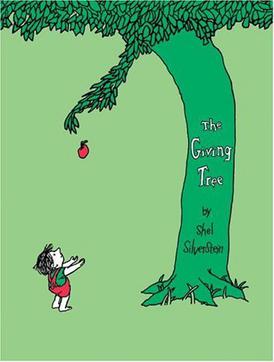 I loved Shel Silverstein's The Giving Tree
 as a kid. I loved reading it to my little brother when I was in middle school. I took it with me to college. And it has survived every weeding-out of my bookshelf ever since. It's been sitting on my shelf, mostly untouched, for years. But I've found myself reading it to toddlers several times in the last few months. And it has me deeply conflicted.
For those of you who need a refresher, the basic premise of the story is this: a tree and a little boy are best friends. As the boy grows up, he's no longer interested in playing with the tree. Trying to make the boy happy, the tree gives more and more of herself (her branches to build a house, her trunk to build a boat), until the boy (now a man) has chopped her down to a stump. In the end, the boy comes back as an old man, needing a place to sit and rest -- and then, finally, both he and the tree are really happy again.
Reading this book as an adult, it's clear to me that Silverstein is trying to convey the sense that material things don't make you happy. Seeking wealth and belongings just keeps the boy coming back for more. The only times he is really satisfied are when he's playing or sitting with the tree, enjoying their friendship. That is a good environmental message: more relationships, less stuff.
I do think that message may get through to kids a little. At least on a more simplistic level, one four year old remembered it to me as "the book about the boy and the tree that are best friends." That was probably my first take-away message as well: you can befriend the natural world. Another good message for kids.
And yet, I can't get over this: the boy cuts down an entire tree. And the tree asks him to do it, thinking she'll make him happy. I can't help worrying that this plants somewhere in kids' minds the idea that it might be ok to cut down trees. Not good. (Feminists also note stereotypical gender roles: the tree is female, reinforcing the idea that women give everything and men just take. Also bad.)
My solution? At least at the toddler level, I've been keeping a running commentary. "Oh, how sad! The tree doesn't have any branches anymore!" "It seems like that didn't really make the boy happy, did it?" That kind of thing. Maybe that will let me keep reading one of my favorite books from childhood.


Friday, October 2, 2009
Like Sands Through the Hourglass, These are the Sine Waves of Our Lives
Does it feel like the days are getting shorter very quickly? You're not imagining it. From mid-August to the beginning of November, we lose at least two and a half minutes of sunlight a day. Today, we'll have 17 minutes less sunlight than we did a week ago, and an hour and 15 minutes less of sunlight than we did a month ago.
Rather than dwelling on how depressing it is to have shorter and shorter days, we'd like to point out a cool pattern in nature. It turns out that day length is a lovely sine wave:
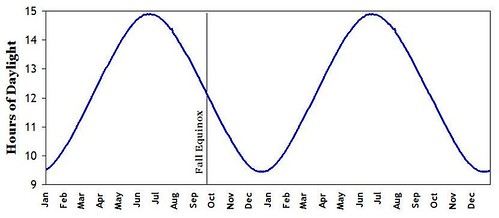
The times shown here are for the latitude of Washington, DC. As you move toward the equator, the curve flattens out; at the equator, days are about 12 hours long all year round. As you move toward the poles, the curve gets more extreme. Thus, the arctic circle's midnight sun in the summer and endless nights in the winter.
Temperatures follow a curve of a similar shape, but they're lagged behind daylight.
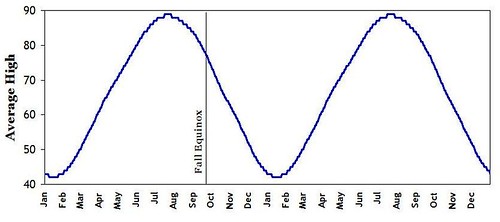
Because the earth has so much mass, it takes a while for the surface to cool off in the winter or warm up in the spring. So, even though we'll be back to having 12 hours of light by mid-March, we won't be back to average highs in the 70's until late April.
Ok, now we're depressed again. We'll just have to enjoy the symmetry of it all.
Rather than dwelling on how depressing it is to have shorter and shorter days, we'd like to point out a cool pattern in nature. It turns out that day length is a lovely sine wave:
The times shown here are for the latitude of Washington, DC. As you move toward the equator, the curve flattens out; at the equator, days are about 12 hours long all year round. As you move toward the poles, the curve gets more extreme. Thus, the arctic circle's midnight sun in the summer and endless nights in the winter.
Temperatures follow a curve of a similar shape, but they're lagged behind daylight.
Because the earth has so much mass, it takes a while for the surface to cool off in the winter or warm up in the spring. So, even though we'll be back to having 12 hours of light by mid-March, we won't be back to average highs in the 70's until late April.
Ok, now we're depressed again. We'll just have to enjoy the symmetry of it all.
Friday, September 25, 2009
America's Best Idea
Writer/producer Dayton Duncan perfectly captures why we agree that National Parks are one of the best things about this country:
By virtue of being an American, whether your ancestors came over on the Mayflower or they just arrived, whether you're from a big city or from a rural state, whether your daddy owns the factory or your mother is a maid, you -- you -- are the owner of some of the best seafront property the nation's got. You own magnificent waterfalls, you own stunning views of mountains and canyons. They belong to you. They're yours. And all that's asked of you is to put it in your will, for your children, so that they can have it too...Hopefully, you'll provide for proper maintenance of this property that is yours. But that's all you've got to do. Now, that's quite a bargain.Tomorrow (Saturday, September 26), the National Park Service and the National Park Foundation are throwing a party with Ken Burns, on the Ellipse from 5:00 to 8:30 PM. From 5:00-7:00 there will be live music, free ice cream, and activities sponsored by the 14 local national parks. At 7:00 there will be a preview of the documentary.
If you can't make it tomorrow, PBS has made a half hour preview available on YouTube - check it out, and be inspired:
Friday, August 21, 2009
Air Conditioning and the Outdoors
I spent my high school years, and some college summers, living in Gainesville, Florida. One of those summers, I biked a few miles to work every day. Some days, the air was so thick with humidity it felt like you could cut it with a knife. Most afternoons, the humidity would come to a head in a brief thunderstorm -- and when it was over, the rain would rise right back up as steam.
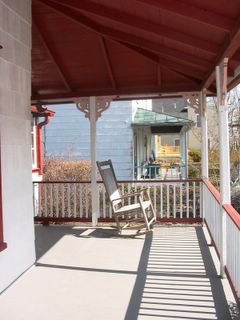 I spent a lot of time outdoors that summer -- especially some memorable evenings on my friend's front porch. She was renting a house with no air conditioning, so the porch was just as comfortable temperature-wise as the indoors -- plus there was a big hammock. It was a full evening of entertainment just to sit out there, chatting with friends, having a beer and watching the people go by.
To this day, I am a big fan of porch-sitting. So is my next-door neighbor, who's in his 70's. We'll sit and watch the birds in our yards, and chat across the banisters for a bit. Almost every house in our neighborhood has a porch, but we rarely see anyone else just sitting on theirs. My theory? Air conditioning has killed the porch, and along with it, part of people's experience of the outdoors.
Consider this: with the windows closed and the a/c on, it's harder to hear anything outdoors. And we don't really want to go outdoors, because it's so much nicer inside. When we do go out, the heat feels worse because we're not used to it. And, in the long run, we're each doing our tiny little part in making it even hotter out there, by using electricity to run the a/c in the first place.
I'm not a purist -- Matt and I do turn our a/c on several times every summer, usually when we're having people over, or when it's still so hot and humid at 10:00 PM that it's hard to sleep. But do I think leaving it off most of the time makes us more willing and able to go outdoors.
How about you? Is a/c the only way you can live through a DC summer, or do you try to moderate your use of air conditioning? Do you think it makes you more or less willing to spend time outdoors?
I spent a lot of time outdoors that summer -- especially some memorable evenings on my friend's front porch. She was renting a house with no air conditioning, so the porch was just as comfortable temperature-wise as the indoors -- plus there was a big hammock. It was a full evening of entertainment just to sit out there, chatting with friends, having a beer and watching the people go by.To this day, I am a big fan of porch-sitting. So is my next-door neighbor, who's in his 70's. We'll sit and watch the birds in our yards, and chat across the banisters for a bit. Almost every house in our neighborhood has a porch, but we rarely see anyone else just sitting on theirs. My theory? Air conditioning has killed the porch, and along with it, part of people's experience of the outdoors.
Consider this: with the windows closed and the a/c on, it's harder to hear anything outdoors. And we don't really want to go outdoors, because it's so much nicer inside. When we do go out, the heat feels worse because we're not used to it. And, in the long run, we're each doing our tiny little part in making it even hotter out there, by using electricity to run the a/c in the first place.
I'm not a purist -- Matt and I do turn our a/c on several times every summer, usually when we're having people over, or when it's still so hot and humid at 10:00 PM that it's hard to sleep. But do I think leaving it off most of the time makes us more willing and able to go outdoors.
How about you? Is a/c the only way you can live through a DC summer, or do you try to moderate your use of air conditioning? Do you think it makes you more or less willing to spend time outdoors?
Friday, August 7, 2009
Nooks and Crannies, Boutiques and Hot Spots
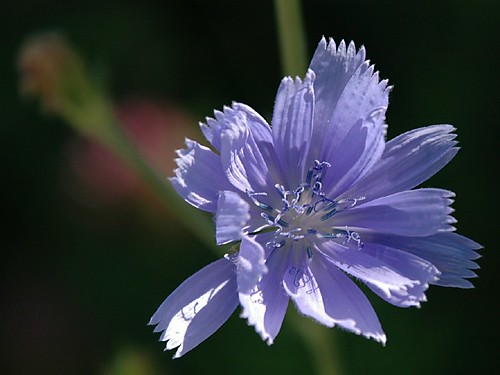 Last summer on my way to the Silver Spring metro in the mornings, I often passed by a vacant lot on Fenton St. that had lots of chicory growing in it. And perching on the chicory were often goldfinches. Some days, I'd be treated to whole, swooping flocks of them. It made me appreciate the little nooks and crannies in this otherwise-urban landscape that allow nature to creep in. You don't always have to go to a big park to see nature.
 Then, one day, someone mowed down all the weeds, and the birds moved on. The lot is now slated for development.
My little plot of chicory wasn't exactly Paradise. But I'll miss the goldfinches on my walk to work. And, soon, in their place, we probably will actually have a boutique and a hot spot. Which brings me to our special guest appearance for today:
Do you have a little patch of nature that you appreciate within the hustle and bustle of the city? Leave a comment and let us know about it (before it's gone).
Friday, July 17, 2009
Seven Ways to Keep a Nature Journal
 I started keeping a journal in third grade, when someone gave me a little blue journal with a brass lock. I didn't start a nature journal until much more recently. But I wish I'd started earlier.
There's no right way to keep a nature journal. But it is a very good thing to keep one. What type you keep depends on your personality and interests. Try a few approaches and see which works for you.
The "five year" journal. In a pre-printed 5-year diary (like
 these
these ), there is typically one page for each day of the year; each is divided into five sections. You have just a few lines to write down your observations for each day. My grandmother recently received in the mail several five-year journals kept by my great-great-uncle in the early 1900's, and they were fascinating: fiddle gigs, cow mating, losing a finger in a sawmill, that kind of thing. Matt and I were inspired to start our own, focusing on nature observation. We use looseleaf paper in a 3-ring binder, and instead of having 1 page per day, we've collapsed it into 5-day windows (observations for January 1-5 are mixed together on one page). We're just now getting to the place where we started it last summer, and it's been very helpful in planning hikes, berry-collecting expeditions, and posts for this blog!
Longer reflections. Perhaps you'd rather have more space to reflect on your observations. It doesn't take a fancy book -- I've got a $1 composition book from CVS that I use to record my thoughts. The important thing, in my mind, is for it to be small and light enough that you can carry it with you, but big enough that you can write a coherent thought without having to turn the page. It can be rewarding to look back through a journal like this and see all you've learned, or be reminded of the wonderful things you've seen. You may want to keep a separate nature journal, or consider just journaling more about nature in a journal you already keep.
Detailed observations. You can also use journaling as a method for learning about individual plants and animals, in-depth. Carefully drawing a plant or animal is a fantastic way to force yourself to really observe. Watching the same individual over time, and noting your observations, you will learn even more. How do the flowers turn into seed pods? What does the plant look like when it first emerges in the spring?
Photography. Of course, photos can be another tool for recording your nature observations and making statements about what you find beautiful in nature. By taking the time to sort and label our photos (and weed them out!) every time we upload them, we've made our photography habit into another tool for remembering what to look for when. As an added bonus, set your screensaver to make a slideshow of your photos -- you'll look at them more often.
Blog. Many blogs are just online journals. We've got a sporadic one here. Same content as other journals; it's just a different format (after all, blogs started as "web logs"). It's free to set one up on Blogger, Word Press, and other sites. And you can tell your mom and your friends about all the cool things you see. The drawback: it's hard to blog in the field. And the pressure to write things worthy of public consumption may keep you from just jotting things down that you otherwise might want to keep a record of. (Ours often goes months without an update.)
Kids' Journals. Just like adults, kids can use a simplified version of almost any of these methods. Take some drawing supplies on a walk, and draw something while you take a break. Or pick one favorite thing to write about when you get back. Or write down one thing you observed for each sense: the cool water, the sour wood sorrel, the chirping birds, the musty soil, the bright red flower. You can also paste in leaves and dried flowers, make bark rubbings...anything you can think of. A looseleaf binder can give a lot of flexibility for what goes into a kid's journal; or use a sketch pad with blank pages. I promise this will be a treasured keepsake, iif you use it frequently.
Life lists. Somehow keeping life lists (a list of birds or plants you have seen in the wild, over your whole life) just for the sake of generating the longest list possible seems to me to miss the experience of just enjoying whatever comes along, wherever you are. But we do make little notes in the margins of our id books about the first time we identify a species of wildflower or bird, and where we saw it. If we find ourselves identifying the same thing again, it's somehow helpful to have that note and make the association to the last time we saw it -- usually we don't have to look something up more than twice. As another point in favor of keeping a life list, just the act of writing down the name of something you've identified can help you remember it.
Do you keep a nature journal, or just dream of doing it? Have tips on journaling? Leave a comment!
Friday, July 10, 2009
Open Your Eyes: Practice Seeing More
 |
The thing is, if you spend all of your time in nature in this kind of tunnel vision, you may miss out on the opportunity to see some interesting things. Here are three exercises we have learned to practice seeing in different ways.
Shift your focus. With this method, you keep your focused vision, but you move your focus a lot more than you would naturally. Consciously force yourself to shift: near, mid range, and far; treetops, eye level, and ground level. I often make myself do this when I find I've had my eyes looking down on the trail without really thinking about it.
Soften your focus. With this method, you bust open your vision to incorporate a full 180-degree sphere. You will not see specific things as well, but you will find that you can spot motion much more easily. We often use this technique to spot birds we're looking for. To practice, hold your hands out in front of you, shoulder-level, and wiggle your fingers. Now move them apart from each other, to each side, until you can just barely see both of them at once. Put your arms down, but keep your eyes softened in this way. It's a whole different world.
Savor it. Rachel Carson wrote, "if this were a sight that could be seen only once in a century or even once in a human generation, this little headland would be thronged with spectators." Open yourself to wonder, she said, by asking, "What if I had never seen this before? What if I knew I would never see it again?" Perhaps you'd look a little longer, a little closer. Go ahead and do it now.
Do you know other tricks for opening up your vision? Have experiences to share with one of these? Post a comment!
Friday, June 26, 2009
Beat the Heat
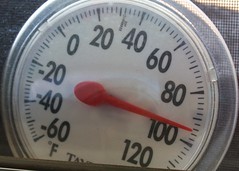 As the summer heats up, don't let it keep you inside all day. Here are some tips for keeping cool outdoors.
More plants, less pavement. Pavement acts as a heat sink, capturing the sun's heat. Plants, meanwhile, are taking the same solar energy and using it to perform the chemical reactions of photosynthesis. They're also evaporating water from their leaves, which cools the air around them.
 Seek shade. Clearly, the shade of trees will help. Also consider walking in areas that are even more intensely shaded, like north-facing slopes and creek ravines. How about Soapstone Valley in Rock Creek Park (previous post)? For a spot that gets no sunlight, ever, check out the Dalecarlia Tunnel, where the Capital Crescent Trail passes under MacArthur Blvd (map). It is deliciously cool all summer.
Find water. Being wet will help you stay cool. Find a creek to stick your feet in briefly, or make your whole excursion a wade in a creek. Just be safe -- don't wade (or swim) where there's a strong current.
 Drink water. Remember to bring lots of water and stay hydrated. Even better, freeze your water bottle before you go and you'll have cold water on your hike (remember to leave room for the water to expand before you put it in the freezer).
Acclimate. Your body makes physiological changes to deal with heat. If you spend most of your time in cold, dry air conditioning and then try to spend time in the hot, humid outdoors, you'll be physically less able to deal with the heat. Spend more time outdoors, and set your thermostat to a higher temperature. It will take a few days for your body to adjust, but you should find the heat more bearable.
Go early. Even if you're acclimated, there's no reason to be out at the hottest time of day. If we're going out (or working in the garden), we'll do it early and be back inside before noon. On a typical summer day, heat will continue building until 3:00 or 4:00 in the afternoon; after that it may start to cool off a little as the sun goes lower in the sky, but it still won't be as cool as it was in the morning.
Take it easy. Similarly, there's no reason to push too hard. If you're feeling wiped out by the heat, take a break. Listen to the birds. Sit by some flowers and watch the pollinators. You may find that you cover less ground, but see just as much.
Do you have a favorite cool spot or a tip for keeping cool? Post a comment.
Friday, June 19, 2009
On Fathers (and Daughters)
On my commute, I've been reading a book of essays by geneticist/journalist/environmental activist David Suzuki that my father gave me. The other day, I got all choked up over a piece that centered around a speech that Suzuki's daughter, Severn, gave at the 1992 Earth Summit in Rio:
One thing clearly at work here was the role of Severn's father -- he took her fishing and hiking regularly, and showed her his love and curiosity for nature. And he modeled the translation of that love of nature into action, with his work as the host of environmental TV shows and regularly speaking out on environmental issues.
 My own dad was no internationally-known TV host, but he (and my mom) did much the same thing. There's a picture from before I can remember of me, fascinated by a mouse Dad brought home from his lab. Later, he'd take me in to feed crickets to his frogs. We went fishing, hiking, camping, scrambling over rocks, looking under logs, and bringing bugs home as pets. My parents made sure we saved our recycling (even though, in the late 70's, we had to drive to a collection spot to drop it off), and they canvassed for green politicians. They haven't stopped, and neither have my brother and I.
Thanks, Dad. Happy Father's Day!
by geneticist/journalist/environmental activist David Suzuki that my father gave me. The other day, I got all choked up over a piece that centered around a speech that Suzuki's daughter, Severn, gave at the 1992 Earth Summit in Rio:One thing clearly at work here was the role of Severn's father -- he took her fishing and hiking regularly, and showed her his love and curiosity for nature. And he modeled the translation of that love of nature into action, with his work as the host of environmental TV shows and regularly speaking out on environmental issues.
 My own dad was no internationally-known TV host, but he (and my mom) did much the same thing. There's a picture from before I can remember of me, fascinated by a mouse Dad brought home from his lab. Later, he'd take me in to feed crickets to his frogs. We went fishing, hiking, camping, scrambling over rocks, looking under logs, and bringing bugs home as pets. My parents made sure we saved our recycling (even though, in the late 70's, we had to drive to a collection spot to drop it off), and they canvassed for green politicians. They haven't stopped, and neither have my brother and I.
Thanks, Dad. Happy Father's Day!
Friday, May 29, 2009
Want to See More? Use Your Ears.
What is your primary experience of a walk in nature? For most people, it is what you see: the greenery, the scenery, the occasional animal. That's all well and good, but if you really want to experience nature, don't depend just on your eyes. You'll see a lot more if you use other senses to help you know where to look.
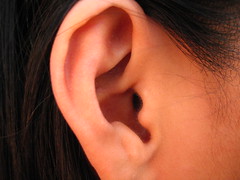 In this post, we'll explore sound: how can your ears help you see animals you might otherwise miss as you're just walking down a trail?
Bird songs. Every bird species has its own distinctive set of songs and calls. It can be an overwhelming task to learn them. Start by just distinguishing among the songs. Some are high-pitched, some are lower. Some have lots of notes, some have just a few. Once you can tell them apart, pick a song and try to spot the bird that goes with it. If you make a connection between the visual and the sound, it's much easier to remember which bird makes which noises. As you learn them, you'll be better able to decide which ones are worth stopping for. That little brown bird? Maybe not. An indigo bunting? We'll stop every time.
Bird alarm calls. In addition to their normal song, most birds also have an alarm call. If you hear several birds in a concentrated area making insistent, repeated chirps, stop and check out what they're so upset about. Sometimes, you won't be able to figure it out. But we have seen many hawks this way, as well as owls, large rat snakes, and foxes.
Other animal alarms. Deer will generally freeze quietly when they first see you, giving you no aural cue to their presence. But if they feel more threatened, they'll snort before they run off -- usually giving you time to spot their white tails in flight. Beavers will let you know they're there as they slap the water with their tail before they duck under the water. If you sit quietly, they might come back up.
Rustling in the leaves. Usually it's just a squirrel. And sometimes a tiny insect can make a big rustle. But if you stop and look when you hear something, you can also be rewarded by something larger: snakes, toads, voles, and other ground-based critters.
Try some of these tricks:
Close your eyes. It's hard to get around the fact that vision is our dominant sense. So try this: stop, close your eyes, and just listen for a while. Try to separate out all the sounds. What do you hear? Is there water nearby? A road? An insect buzzing around your head? How many different birds can you hear?
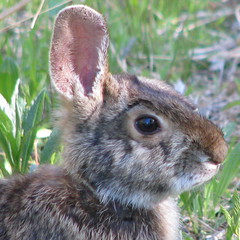 Directional hearing. Many animals have big ears they can point in a certain direction to focus in on a sound. Our ears are a more all-purpose design. But you can mimic the parabolic dish of a dog's ears by cupping your a hand behind each ear and turning your head in the direction you want to focus in on. We do this naturally when we cup a hand behind an ear when we haven't heard someone.
Be quiet. If you are talking loudly with a friend, it will be harder to hear everything around you -- and many animals will run away from you entirely. We have some friends who have agreed to spend the first 10 minutes of every hike together in silence. It's a nice way to center yourself and be present. The rest of your hike will be better for it.
Do you have other ways you use your hearing to experience nature more fully? Experiences with these techniques? Post a comment.
In this post, we'll explore sound: how can your ears help you see animals you might otherwise miss as you're just walking down a trail?Bird songs. Every bird species has its own distinctive set of songs and calls. It can be an overwhelming task to learn them. Start by just distinguishing among the songs. Some are high-pitched, some are lower. Some have lots of notes, some have just a few. Once you can tell them apart, pick a song and try to spot the bird that goes with it. If you make a connection between the visual and the sound, it's much easier to remember which bird makes which noises. As you learn them, you'll be better able to decide which ones are worth stopping for. That little brown bird? Maybe not. An indigo bunting? We'll stop every time.
Bird alarm calls. In addition to their normal song, most birds also have an alarm call. If you hear several birds in a concentrated area making insistent, repeated chirps, stop and check out what they're so upset about. Sometimes, you won't be able to figure it out. But we have seen many hawks this way, as well as owls, large rat snakes, and foxes.
Other animal alarms. Deer will generally freeze quietly when they first see you, giving you no aural cue to their presence. But if they feel more threatened, they'll snort before they run off -- usually giving you time to spot their white tails in flight. Beavers will let you know they're there as they slap the water with their tail before they duck under the water. If you sit quietly, they might come back up.
Rustling in the leaves. Usually it's just a squirrel. And sometimes a tiny insect can make a big rustle. But if you stop and look when you hear something, you can also be rewarded by something larger: snakes, toads, voles, and other ground-based critters.
Try some of these tricks:
Close your eyes. It's hard to get around the fact that vision is our dominant sense. So try this: stop, close your eyes, and just listen for a while. Try to separate out all the sounds. What do you hear? Is there water nearby? A road? An insect buzzing around your head? How many different birds can you hear?
Directional hearing. Many animals have big ears they can point in a certain direction to focus in on a sound. Our ears are a more all-purpose design. But you can mimic the parabolic dish of a dog's ears by cupping your a hand behind each ear and turning your head in the direction you want to focus in on. We do this naturally when we cup a hand behind an ear when we haven't heard someone.Be quiet. If you are talking loudly with a friend, it will be harder to hear everything around you -- and many animals will run away from you entirely. We have some friends who have agreed to spend the first 10 minutes of every hike together in silence. It's a nice way to center yourself and be present. The rest of your hike will be better for it.
Do you have other ways you use your hearing to experience nature more fully? Experiences with these techniques? Post a comment.
Friday, May 22, 2009
One Thing Leads To Another
 A few weeks ago, Matt and I went to Thompson Wildlife Management Area to see the spectacular spring show of trilliums and orchids. At one point, a really large bumblebee caught my eye. As I watched it, the bee flew to a showy orchis that we had walked right past.
I find this phenomenon happens a lot: stop to look at one thing, and you may just notice something else even better. Later that weekend, we slowed down the car to look at a nice violet -- a violet! -- and spotted a type of iris we'd never seen growing in the wild before.
But here's the craziest example I can think of: a four part chain reaction. Last winter, we were at a wildlife refuge in Florida when we slowed down to look at an anhinga. Not so exciting; we had seen lots of them already on the trip. But as we slowed down we noticed a small alligator perched on the bank near the anhinga. Alligators were also a dime a dozen on this trip, but we stopped because it was a cute scene: the alligator looked like it was contemplating lunch in the form of the bird in front of it.
As we were taking some pictures, we noticed some motion off in the far distance. With the binoculars, we were able to see some wild pigs on the edge of the woods. Now that's unusual. Pigs are actually a non-native species that are becoming a nuisance in Florida, but it was neat to see them anyway.
 And then, there was motion much closer to us, in the grass. At this point, our stopping had attracted a few other observers and over the many pairs of binoculars, there was much discussion amongst us. All anyone could see was a pair of ears, and we weren't sure what kind of critter they were attached to. Some people came and went. The ears stayed, and so did we. And eventually, the ears moved to the edge of the grass. Out came a bobcat, into full view.
A once in a lifetime experience. All from stopping for an a bird we had seen a thousand times before.
Friday, May 15, 2009
You Don't See What You're Not Looking For
I recently read a short story in which the two main characters watch a bald eagle that has just caught a snake, as it is mobbed by two screaming gulls.
Too true.
“That was amazing,” said Stacey.
“Want to know what is more amazing?” asked the interpreter. He didn’t wait for her response. “There are at least thirty people in this parking lot...But you and I were the only ones who saw that. For everyone else, it didn’t happen.”
Too true.
Friday, May 8, 2009
On Starting the Day
How do you start your day? Are you jarred out of sleep by reports from the latest war zone or traffic on the beltway? Does your Blackberry start buzzing before you're even out of bed? Do you slug down a cup of coffee and run out the door before you're late for work? Let us propose another option: start your day in touch with nature. Here are some ideas.
Find a sit spot. For the duration of the time it takes you to eat breakfast, turn off all other media and just sit and observe nature. This might mean looking out on your backyard, or a bird feeder you hang from your apartment window. If you're really concrete-bound, you could listen to a CD of bird songs or get yourself a fish tank -- or take a short walk outside.
Make yourself more time. Are you reading this and thinking, "I just don't have time to sit around in the morning"? Sure, the time is not just going to materialize out of thin air. Try going to bed half an hour earlier so you can wake up half an hour earlier. Make the time.
Turn off the alarm. If you don't have to be anywhere in the morning at any particular time, wake up to the birds singing instead of news or music or loud bleeping noises that make you jump out of your skin. Even if you do have to be somewhere at a particular time, if you get into a good sleep schedule, you may find you don't really need an alarm most of the time.
Don't check in. Does it really make a difference whether you see your email at 7:30 instead of 7:00? Once you start checking in, there may be no going back. Just don't do it. Everything will still be there when you're ready for it. And you may find you're much more ready for it if you give yourself some time first.
Try it for a week. See how you feel. You can always go back to the war-report, skip-breakfast, run-out-the-door method if this doesn't work for you.
Find a sit spot. For the duration of the time it takes you to eat breakfast, turn off all other media and just sit and observe nature. This might mean looking out on your backyard, or a bird feeder you hang from your apartment window. If you're really concrete-bound, you could listen to a CD of bird songs or get yourself a fish tank -- or take a short walk outside.
Make yourself more time. Are you reading this and thinking, "I just don't have time to sit around in the morning"? Sure, the time is not just going to materialize out of thin air. Try going to bed half an hour earlier so you can wake up half an hour earlier. Make the time.
Turn off the alarm. If you don't have to be anywhere in the morning at any particular time, wake up to the birds singing instead of news or music or loud bleeping noises that make you jump out of your skin. Even if you do have to be somewhere at a particular time, if you get into a good sleep schedule, you may find you don't really need an alarm most of the time.
Don't check in. Does it really make a difference whether you see your email at 7:30 instead of 7:00? Once you start checking in, there may be no going back. Just don't do it. Everything will still be there when you're ready for it. And you may find you're much more ready for it if you give yourself some time first.
Try it for a week. See how you feel. You can always go back to the war-report, skip-breakfast, run-out-the-door method if this doesn't work for you.
Subscribe to:
Posts (Atom)

