
Showing posts with label November. Show all posts

Thursday, December 3, 2009

LOOK FOR: Persimmon, Fruit of the Gods

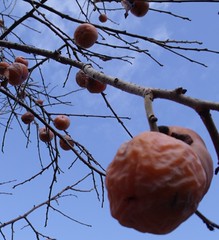
Persimmon fruits hanging from the tree (Diospyros virginiana)I have a very early (and not entirely pleasant) childhood memory of getting pelted with persimmons as my mother shook them out of a tree in the woods near our house. Sometime in my twenties I overcame this trauma, and now I am likely to be the one shaking them town. Their scientific name says it all -- Diospyros virginiana, the Virginian food of the gods.

Persimmons have come up with an ingenious method for protecting themselves until they're fully ripe: they are horribly, mouth-puckeringly astringent when immature. There is a common saying (among folks who eat persimmons, at least) that a frost makes persimmons lose this astringency. This is close, but not exactly true: persimmons ripen up around the time of our first frost, but the two events aren't related. We've found edible persimmons before a frost, and horribly astringent ones after frost.

Persimmons, mushy and ready to eatThe real rule of thumb is that you only want to eat fruit that are gooey-soft and falling off the tree. Give the trunk a gentle shake and collect the fruits that fall. (Beware any fruit that are still attached to a twig when they fall: they weren't actually ready to come down yet.) Before you eat a whole fruit, take a small bite and wait a minute to make sure it's not going to make your mouth feel like it's been sucked dry: the puckering power of the persimmon is definitely related to how much you've eaten. You can take home close-but-not-quite-ripe fruits and let them continue ripening indoors for a week or two. But don't let all this talk of astringency scare you off: when they're good, they're really, really good.
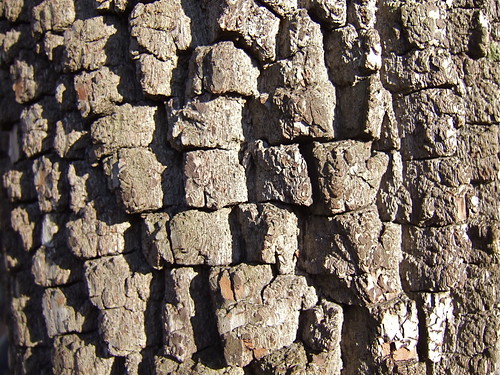
Persimmon bark (Diospyros virginiana)At this time of year, you have two ways of identifying a persimmon tree: by bark, and by fruit. The bark is dark grey and chunky, broken up into squares. Learning to recognize it is key, because the fruits are usually well above eye level. When you see the bark, look up: the fruits are round and orange, about the size of a golf ball, hanging on the tree long after it has lost its leaves. Each fruit has a distinctive four-part sepal on top. There's nothing I can think of that you could confuse them with. So, shake away!

In the wild: Persimmons need sun to set a lot of fruit. You'll often see them on the edges of woods. We know of a few on the C&O Canal between Great Falls Tavern and the falls, and many along the Northwest Branch of the Anacostia north of Colesville Road. And we always keep an eye out for fruit along Eastern Avenue at Jecquie Park in Takoma, where there's a tall persimmon right next to the sidewalk.

In your yard: Persimmons can grow in a wide range of soils. You'll need sun, and room for a tree that will eventually be 20 feet or more. Edible Landscaping has a selection of saplings grafted from trees found in the wild with unusually large fruits. They appear to have also grafted them to be self-fertile, which is important, because wild persimmons have male and female trees.

Do you have a persimmon story, or a favorite spot where you find persimmons? Leave us a comment!

Like the photos in this post? Mouse over for credits; a click takes you to the photographer on Flickr.

Thursday, November 19, 2009

LOOK FOR: Wild Turkeys

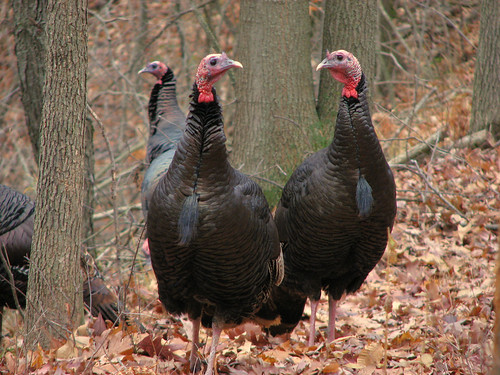
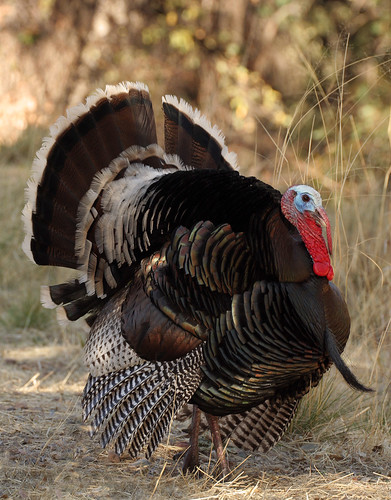
Wild Turkey, Meleagris gallopavoIt's almost Thanksgiving, and everybody's thinking of turkey. But long before Thanksgiving existed, turkeys were here in North America.

Turkeys are among the largest birds in our area, with a wingspan over 4 feet and weighing up to 24 pounds. The stereotypical Thanksgiving pose -- tailfeathers fanned out, feathers fluffed up -- is a display that males put on to attract mates, but also when they feel threatened. Not so surprising, then, that this is our picture of turkeys at Thanksgiving time.

As another display tactic, male turkeys have featherless heads that can be bright blue during mating season, complemented by bright red  throat, wattles (the floppy part under the beak), snoods (a flap that dangles over the beak), and caruncles (other red growths around the neck and head. Males also have a curious tuft of hairs coming out of the middle of their chests called a beard. If he puts on a successful show, each male typically maintains a harem of several females. Meanwhile, the females can get away with being smaller and less colorful -- in fact, they need to be, as they're the ones that tend the nests.

Wild Turkey, Meleagris gallopavo
By the early 1900's, turkey populations in North America had been decimated by hunting. But wildlife managment programs have made a concerted effort to bring the bird back through habitat protection and re-introduction of birds where they had disappeared. For example, the Maryland Department of Natural Resources estimates that the wild turkey population in Maryland has rebounded from about 2,000 turkeys in two or three counties in 1973, to over 30,000 birds in 2008, with wild turkeys in every Maryland county.

In the wild: Turkeys are found throughout Maryland and Virginia in a variety of habitats. In the summer, they seek out areas with berries, grasses, and insects, including both woods and meadows.  In the fall and winter, they may increase the time they spend in the woods as they seek out acorns. Many of the times that we have seen wild turkeys have been along rivers; they tend to nest within a few hundred yards of water.

Wild Turkey, Meleagris gallopavoIn your yard: Wild turkeys have been known to stray into more urban and suburban areas occasionally, but in general, they're very wary of people. (We have to wonder, though, whether domesticated turkeys will get in on the urban poultry phenomenon at some point.)

More info: 
An excellent report from the Maryland DNR: The Wild Turkey in Maryland
Sounds of Wild Turkeys from the National Wild Turkey Foundation

Like the photos in this post? Mouse over for credits; a click takes you to the photographer on Flickr.

Thursday, November 12, 2009

LOOK FOR: White Throated Sparrows, Back for the Winter

White-throated sparrow, Zonotrichia albicollisA few weeks ago, we started seeing white throated sparrows in our yard again. These little birds breed in Canada during the summer, then head south to spend the winter anywhere from Pennsylvania south to Florida, and west to Missouri and Texas.

White throated sparrows often hop around on the ground and forage in the leaf litter, where most of their plumage serves as good camouflage. But their head markings stand out, and lend the bird its scientific name, Zonotrichia albicollis: stripe-headed white-throat. These birds do indeed have white throats, often with a thin, dark border. The stripes on top of the head come in two color variations: either black and white or brown and tan. But perhaps most distinctive is the little patch of yellow just above and in front of the eye (a "lore"). This yellow patch stands out to me so much that this, and not the white throat, is usually how I recognize these birds for who they are.

Some people say the song of the white-throated sparrow sounds like they're saying "Oh sweet Canada, Canada, Canada." I find that helps me remember what bird I'm hearing more than the other mnemonic often used for their song: "Poor Sam Peabody, Peabody, Peabody." Anybody could say that (though I'm not sure why Sam Peabody is so deserving of pity). No, these little guys are clearly longing for their summer home. Have a listen:


White-throated sparrow, Zonotrichia albicollisIn the wild: like many birds, white-throated sparrows like the edges of woods, and suburban backyards. In the winter they eat seeds from grasses and ragweed to grape, rose, and dogwood.

In your yard: White throated sparrows will come to feeders, especially for millet and black oil sunflower seeds, but they prefer to eat the seed scattered on the ground. You can make an area extra-inviting by providing cover (like a brush pile or thicket) and water in a birdbath, pond, or fountain.

Like the photos in this post? Mouse over for credits; a click takes you to the photographer on Flickr.
Thursday, November 5, 2009

LOOK FOR: Witch Hazel, the Last Flowers of the Year

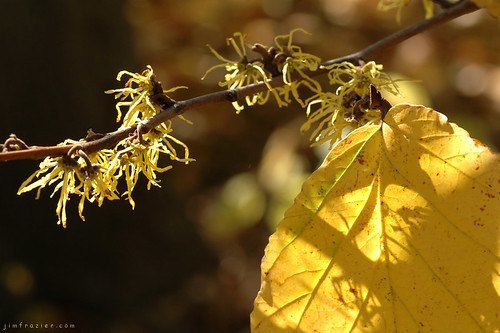
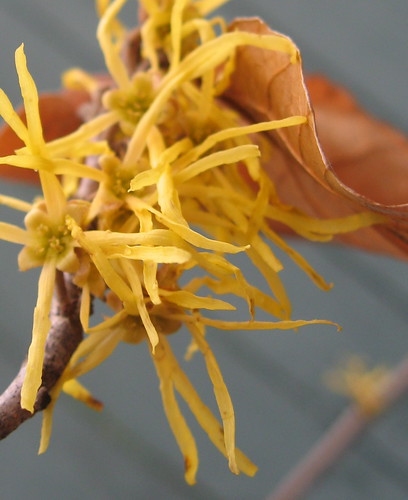
witch hazelAs one of the last things in the DC area to flower in the fall, witch hazel has a special place in my heart. It's not that the flowers are particularly showy -- the petals are just small yellow wisps, really. But the flowers of Hamamelis virginiana start blooming in October, and can keep going until Thanksgiving or even later.

Witch hazel (or witchhazel) is an understory shrub that grows up to 20 feet tall. Its flowers are about a half-inch to an inch wide, and they come in clusters of 3-5, on a little stalk coming off the twigs of the shrub. They'll form clusters of seedpods which explode when they're ripe, shooting their seeds up to 30 feet away. You may see some seedpods on the tree at the same time as the flowers are blooming.

witch hazelThere's another native species of witch hazel that, rather being the last to bloom this year, will be one of the first blooms of next year. Hamemelis vernalis often has redder flowers, and they're slightly smaller. We've never seen it in the wild, so let us know if you see some this winter! There are also Asian species of Hamemelis that are often planted ornamentally that flower in the winter.

Many people have heard of witch hazel because the bark and leaves have a long history of medicinal use as an astringent. But the "witch hazel" you can now buy in a store actually has very little witch hazel in it. It's made by soaking the leaves or bark in water, distilling it, then adding alcohol. People disagree on whether witch hazel actually has any effectiveness after the distillation process -- it may be the alcohol that's doing most of the good when you use this product. We've never tried making our own -- this tree just isn't common enough to justify it.

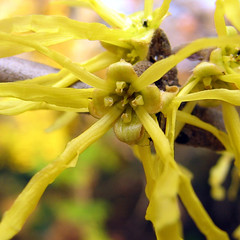
close-up of witch hazel bloomIn the wild: Witch hazel likes moist soil, though we've also seen it on dry mountainsides. They're scattered along the Valley Trail in Rock Creek Park -- on our last hike we noticed several directly across Rock Creek from Picnic Area 8 that were in bloom. There used to be a nice stand of small witch hazels on the Rachel Carson trail north of Colesville Road, but a couple of years ago they were taken out by beavers. We'll have to check on whether they've managed to come back.

In your yard: Garden books recommend them, but the witch hazel we planted a few years ago still seems to struggle in the summer. All trees want a lot of water in their first year after planting, but this one perhaps more so.

Where have you seen witch hazel in the DC area? Leave us a comment below.

Like the photos in this post? Mouse over for credits; a click takes you to the photographer on Flickr.