
Showing posts with label Plants - Winter. Show all posts

Friday, February 26, 2010

LOOK FOR: Skunk Cabbage, First Flower of the Year

If you are afflicted with melancholy at this season, go to the swamp and see the brave spears of skunk-cabbage buds already advanced toward a new year...There is no can’t nor cant to them. They see over the brow of winter’s hill. They see another summer ahead.  -- Henry David Thoreau

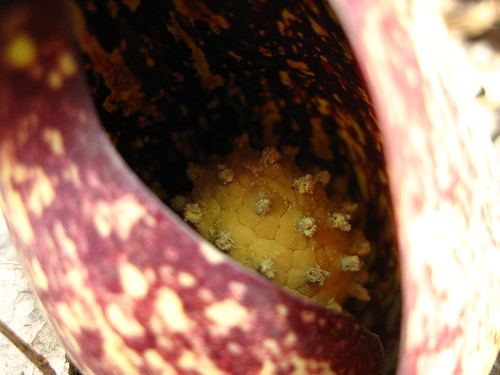
skunk cabbage spadix inside the spathe
Photo credit: gareandkitty
So much of the diversity in the natural world is the result of plants and animals figuring out how to survive in territory where others can't. A few weeks ago, we talked about rock tripe and how it manages to pluck enough moisture and nutrients from the air that it can colonize rock surfaces. Today, we bring you skunk cabbage -- which not only survives in a wetland environment many plants find inhospitable, but manages to attract pollinators in late winter, when nothing else is flowering.
To attract those pollinators, skunk cabbage relies more on guile than on charm. The skunk cabbage flower is no sweet-smelling bull's eye like most of the flowers we'll see later in the year. In fact, it stinks. Somehow, this plant has figured out how to make the molecules cadaverine (normally put off by rotting flesh) and skatole (otherwise found in scat). And with them, it attracts flies and beetles seeking a meal.

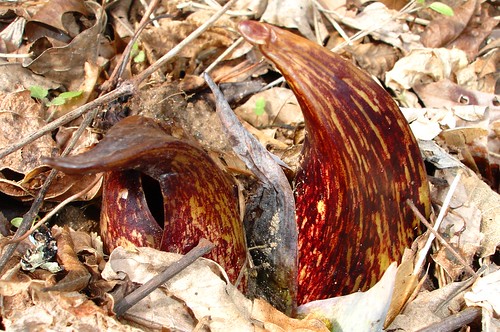
skunk cabbage spathes
Photo credit: cyanocorax
The flowers continue their deception with a streaky reddish-purple spathe (the hood-shaped bract around the flowers) that is not unlike the color of carrion these insects are seeking. Inside that hood is a spadix made up of dozens of flowers, which get inadvertently pollinated by insects seeking a stinky bite to eat.
And skunk cabbage has one more trick up its sleeve (or should we say, spathe). Amazingly, it produces its own heat -- it may be 50 degrees or more above the ambient air temperature when the female flowers are in full bloom. This brings in more insects. For one thing, the warmth makes the stinky carrion smells more volatile. And insects might expect a piece of carrion to be warm, because of the heat released by the bacteria that are breaking it down.

skunk cabbage in snow
Photo credit: Hljod.Huskona
But some insects just seem to want a little vacation from winter, like the rest of us do. Skunk cabbage can be warm enough to melt snow and ice, which surely feels good to insects trying to make a living at this time of year. The flowering season for skunk cabbage can vary by the weather, but in the Washington DC area they can start flowering in January and may go as late as March.

So, if you've been feeling the melancholy of the season, or having trouble seeing the summer ahead...it's a great time to start looking for flowers.

skunk cabbage flowers
Photo credit: Colin Purrington
In the wild: Skunk cabbage tends to grow in relatively flat areas that stay wet or muddy for most of the year. Look along small streams and seeps -- perhaps even growing in shallow water. There are many patches of skunk cabbage in Rock Creek Park and lots of other local parks. You may have noticed it in the summer with its large clumps of 2-foot-long leaves growing close to the ground. Right now you won't see much hint of the leaves -- you're just looking for the purplish spathes poking up from the ground.

In your yard: You won't have much luck growing skunk cabbage unless you've got a wetland in your backyard. If you do, go for it -- skunk cabbage are deer resistant, and that foliage is hard to beat.

Thursday, February 18, 2010

LOOK FOR: Maple Sap (and Pancakes)

maple sap coming out of spile
Photo credit: sighthound
Every spring, as temperatures rise, trees start to wake up from their dormancy. They've been storing energy  all winter as starch in their wood. But now, they want to use it to start producing leaves. And the way they get that energy to their leaves? Sap.

There's a particular window of opportunity for maple sap that is determined by temperature. When the temperature of the wood rises to the mid-30s, enzymes start to convert the stored starch into sugar. And once the tree warms up to about 45 degrees, the starch stops converting into sugar. In between, when days are relatively warm but the nights are relatively cold, pressure builds up in the tree, and the sap comes pouring out of any wounds -- particularly a wound that was put there intentionally to direct that sap into a bucket.

tasting maple sap from the spile
If you taste the sap when it comes out of a tree, it will be only very slightly sweet; the sap is usually less than 3 percent sugar. In contrast, maple syrup is typically around 66 percent sugar. To get from 3 to 66 percent, you have to boil off an enormous amount of water. A single tap may release 10 to 20 gallons of sap from a tree over the several weeks that the sap is running. But that 20 gallons of sap boils down to less than a gallon of syrup. No wonder it's so expensive!

maple sap bucket
Photo credit: Lolly Knit
Several local parks have demonstrations of making maple syrup -- browse our calendar for many of them. But perhaps most noteworthy is the one that's going on Feb 20-21 at Wheaton Regional Park (11 to 3 on both Saturday and Sunday). They'll have someone to explain the whole process and opportunities to taste both fresh sap and finished maple syrup, the latter ladled over little pancakes for your tasting pleasure. Weather permitting, they'll have a vat of sap boiling over the fire all weekend. We may see you there!

Do you have any maple syrup stories to share? Leave us a comment.

Like the photos in this post? Mouse over for credits; a click takes you to the photographer on Flickr.

Thursday, January 14, 2010

LOOK FOR: Hemlock Trees (While You Still Can)

Eastern hemlock, tsuga canadensis
Eastern Hemlock (Tsuga canadensis) is a majestic tree sometimes called the "redwood of the East." They can form tranquil evergreen groves in the understory, but really, they're just waiting for their big break. When a tree falls and opens a spot in the canopy, hemlocks will shoot up -- eventually reaching heights of 80 or even 100 feet over their 350 year lifespan. In the second-growth forests of the DC area, though, you'll see only scattered trees, and they're rarely taller than 15 or 20 feet tall.

Because they're evergreen, this is a great time of year to look for hemlocks, when other trees have lost their leaves. The needles of hemlock will help you distinguish this tree from other evergreens in our area: they are flat, about 3/4 of an inch long, and grow in a plane off the twigs. The overall form of hemlocks can also be distinctive:  branches grow horizontally from the trunk, but are floppy on the ends as the twigs haven't hardened up yet. Up close, you may notice very small cones on the trees -- they look like pine cones, but much smaller.

cones on eastern hemlock (Tsuga canadensis)
The genus name, Tsuga, is a Japanese word supposedly meaning "mother tree." Unfortunately the relationship between North American and Japanese hemlocks is not so nurturing. Around 1911, some imported hemlocks bound for a Japanese garden in Richmond came bearing an insect known as the hemlock woolly adelgid (uh-DELL-jid). This relative of the aphid is just a minor pest in Japan, where it's got several predators and the trees have some natural resistance. For our local Tsuga canadensis, though, infestation by the woolly adelgid is usually fatal within 4 to 10 years.

It wasn't until the 1980's that people started noticing that the adelgid had spread from ornamental plantings in Richmond to native trees in York River State Park and Shenandoah National Park. By the mid-90's, the adelgid had spread to Connecticut and Massachusetts, and it is now considered established throughout the hemlock's eastern range, from Maine to Alabama. Experiments are being done with the release of adelgid-eating beetles from Japan, but results don't seem very promising, and many stands of hemlock have already been lost. (To see some of the destruction to old growth hemlock groves, see this video from the Charlotte Observer.)

eastern hemlock (Tsuga canadensis) at Scott's Run Nature PreserveThere are two morals to this story. First, garden with native plants, so that you don't unwittingly import a pest that will devastate an entire species. Second, get out there and appreciate what we've got, while you can.

In the wild: We're not aware of any really large hemlocks in the DC area (do let us know!) but there are still some small hemlocks scattered in our local forests. The most we've noticed are at Scott's Run Nature Preserve in McLean -- they grow right along several of the trails there (like the one shown here).

In your yard: It's probably better not to bother planting hemlocks unless and until someone figures out how to control the adelgids. Too bad, because they're beautiful trees.

Like the photos in this post? Mouse over for credits; a click takes you to the photographer on Flickr.

Thursday, December 17, 2009

LOOK FOR: Holly, a Symbol in Winter Long Before Christmas

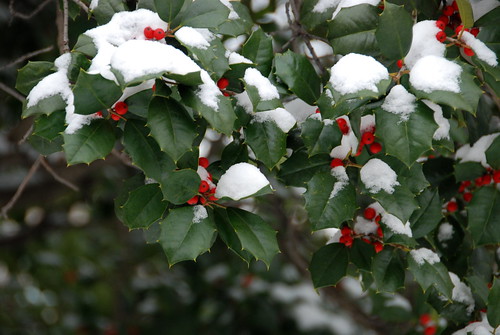
 holly in snowDecking the halls with boughs of holly is a tradition that pre-dates Christmas by quite a while. Romans used holly as a decoration and a gift for Saturnalia, a festival that took place around the winter solstice. Similarly, the Celts would place boughs around their house in the winter for protection and good luck. These traditions were absorbed by the Christian church, and holly became a common Christmas decoration.

Although decorating with holly started as a European tradition, hollies are native to North America as well. Many species are quite different from our classic idea of a holly tree -- some lose their leaves, some have black berries. But Ilex opaca, known as American holly, has the distinctive spiny, evergreen leaves and bright red berries that have been treasured as a winter decoration for millenia. Early colonists noticed them, too, and holly became an entrenched symbol of Christmas in North America.

cedar waxwing eating a holly berryHolly berries are important food for birds, but poisonous to humans. Birds tend to wait a while into the winter before they start eating them -- repeated freezing and thawing can soften them up and make them more palatable. Meanwhile, we get to enjoy their decoration in the woods. The trees are dioecious -- meaning each tree is either male or female. At this time of year, if you spot a holly without berries, there could be several explanations: 1) it's a male; 2) it's a female without a male nearby; 3) its berries have been completely devoured relatively early in the season, or 4) it doesn't get enough light to set fruit.

In the wild: Ilex opaca is scattered throughout the woods of the Washington, DC region. They can grow up to 40 feet, but it's more common to see shorter trees. Now is a great time to spot them, because the evergreen leaves will stand out when other trees have lost their foliage.

In your yard:  Holly is a great addition to a yard: for winter interest, habitat value, and as an evergreen screen. They prefer acidic soil. European and asian species are also sold in nurseries; ask for the native Ilex opaca. Compared to imported species, the native should have the most wildlife value -- although birds will eat the berries of most species, insects that have evolved relationships with the leaves of the native may not be able to survive off imports. And those insects serve as more bird food, throughout the year. 

Like the photos in this post? Mouse over for credits; a click takes you to the photographer on Flickr.

Thursday, December 3, 2009

LOOK FOR: Persimmon, Fruit of the Gods

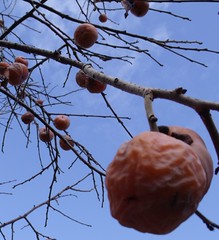
Persimmon fruits hanging from the tree (Diospyros virginiana)I have a very early (and not entirely pleasant) childhood memory of getting pelted with persimmons as my mother shook them out of a tree in the woods near our house. Sometime in my twenties I overcame this trauma, and now I am likely to be the one shaking them town. Their scientific name says it all -- Diospyros virginiana, the Virginian food of the gods.

Persimmons have come up with an ingenious method for protecting themselves until they're fully ripe: they are horribly, mouth-puckeringly astringent when immature. There is a common saying (among folks who eat persimmons, at least) that a frost makes persimmons lose this astringency. This is close, but not exactly true: persimmons ripen up around the time of our first frost, but the two events aren't related. We've found edible persimmons before a frost, and horribly astringent ones after frost.

Persimmons, mushy and ready to eatThe real rule of thumb is that you only want to eat fruit that are gooey-soft and falling off the tree. Give the trunk a gentle shake and collect the fruits that fall. (Beware any fruit that are still attached to a twig when they fall: they weren't actually ready to come down yet.) Before you eat a whole fruit, take a small bite and wait a minute to make sure it's not going to make your mouth feel like it's been sucked dry: the puckering power of the persimmon is definitely related to how much you've eaten. You can take home close-but-not-quite-ripe fruits and let them continue ripening indoors for a week or two. But don't let all this talk of astringency scare you off: when they're good, they're really, really good.

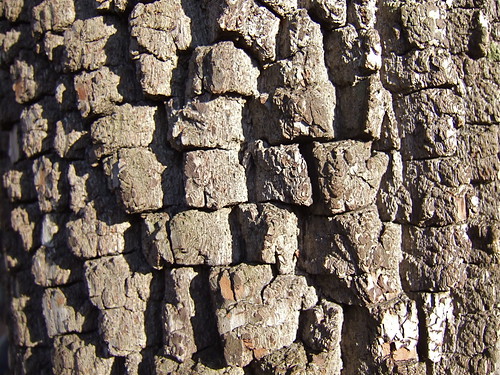
Persimmon bark (Diospyros virginiana)At this time of year, you have two ways of identifying a persimmon tree: by bark, and by fruit. The bark is dark grey and chunky, broken up into squares. Learning to recognize it is key, because the fruits are usually well above eye level. When you see the bark, look up: the fruits are round and orange, about the size of a golf ball, hanging on the tree long after it has lost its leaves. Each fruit has a distinctive four-part sepal on top. There's nothing I can think of that you could confuse them with. So, shake away!

In the wild: Persimmons need sun to set a lot of fruit. You'll often see them on the edges of woods. We know of a few on the C&O Canal between Great Falls Tavern and the falls, and many along the Northwest Branch of the Anacostia north of Colesville Road. And we always keep an eye out for fruit along Eastern Avenue at Jecquie Park in Takoma, where there's a tall persimmon right next to the sidewalk.

In your yard: Persimmons can grow in a wide range of soils. You'll need sun, and room for a tree that will eventually be 20 feet or more. Edible Landscaping has a selection of saplings grafted from trees found in the wild with unusually large fruits. They appear to have also grafted them to be self-fertile, which is important, because wild persimmons have male and female trees.

Do you have a persimmon story, or a favorite spot where you find persimmons? Leave us a comment!

Like the photos in this post? Mouse over for credits; a click takes you to the photographer on Flickr.

Thursday, November 5, 2009

LOOK FOR: Witch Hazel, the Last Flowers of the Year

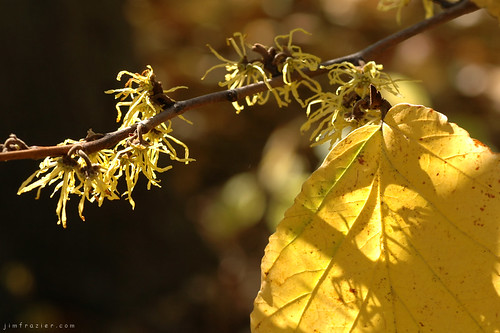
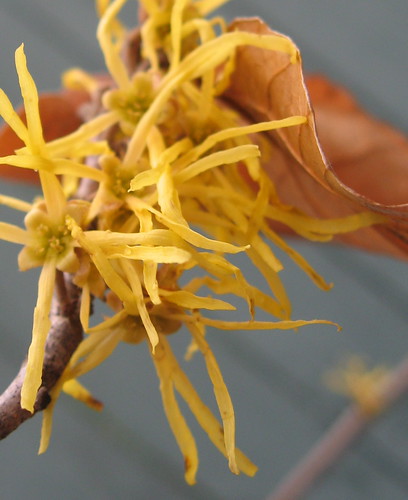
witch hazelAs one of the last things in the DC area to flower in the fall, witch hazel has a special place in my heart. It's not that the flowers are particularly showy -- the petals are just small yellow wisps, really. But the flowers of Hamamelis virginiana start blooming in October, and can keep going until Thanksgiving or even later.

Witch hazel (or witchhazel) is an understory shrub that grows up to 20 feet tall. Its flowers are about a half-inch to an inch wide, and they come in clusters of 3-5, on a little stalk coming off the twigs of the shrub. They'll form clusters of seedpods which explode when they're ripe, shooting their seeds up to 30 feet away. You may see some seedpods on the tree at the same time as the flowers are blooming.

witch hazelThere's another native species of witch hazel that, rather being the last to bloom this year, will be one of the first blooms of next year. Hamemelis vernalis often has redder flowers, and they're slightly smaller. We've never seen it in the wild, so let us know if you see some this winter! There are also Asian species of Hamemelis that are often planted ornamentally that flower in the winter.

Many people have heard of witch hazel because the bark and leaves have a long history of medicinal use as an astringent. But the "witch hazel" you can now buy in a store actually has very little witch hazel in it. It's made by soaking the leaves or bark in water, distilling it, then adding alcohol. People disagree on whether witch hazel actually has any effectiveness after the distillation process -- it may be the alcohol that's doing most of the good when you use this product. We've never tried making our own -- this tree just isn't common enough to justify it.

close-up of witch hazel bloomIn the wild: Witch hazel likes moist soil, though we've also seen it on dry mountainsides. They're scattered along the Valley Trail in Rock Creek Park -- on our last hike we noticed several directly across Rock Creek from Picnic Area 8 that were in bloom. There used to be a nice stand of small witch hazels on the Rachel Carson trail north of Colesville Road, but a couple of years ago they were taken out by beavers. We'll have to check on whether they've managed to come back.

In your yard: Garden books recommend them, but the witch hazel we planted a few years ago still seems to struggle in the summer. All trees want a lot of water in their first year after planting, but this one perhaps more so.

Where have you seen witch hazel in the DC area? Leave us a comment below.

Like the photos in this post? Mouse over for credits; a click takes you to the photographer on Flickr.