
Showing posts with label Plants - July. Show all posts

Thursday, July 30, 2009

LOOK FOR: Jewelweed

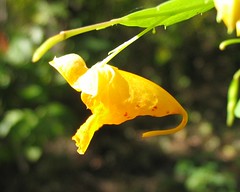
Jewelweed is a pretty flower, a sparkly wonder, a trailside snack, and a soothing skin treatment. What's not to love?

There are actually two species of jewelweed in our area: Impatiens biflora, which has darker orange flowers, often in pairs, and Impatiens pallida, with paler yellow flowers. Both have darker orange or red spots. And yes, they are relatives of the common garden impatiens (the genus includes hundreds of species) -- but unlike the impatiens in my mom's yard, jewelweed can grow 3-5 feet tall.

Water beads up on the dusky-colored leaves of jewelweed, creating sparkling jewels after a rain. According to Steve Brill, they also look beautiful underwater: the undersides of the leaves will turn silvery.

The flowers and seeds of jewelweed are edible. But you'll have to be careful to collect any seeds. Another common name for jewelweed is "touch-me-not": the seedpods will explode when you touch them. Of course, this is fun in itself -- but if you surround the seedpod with your whole hand and squeeze, it should explode in your hand, and you can try the nutty little seeds.

Jewelweed also provides food for wildlife: the bright, trumpet-shaped flowers can attract hummingbirds and butterflies. If you sit by a patch for a little while, you're sure to at least see bees crawling inside the flowers for the nectar.

The flowers and seeds are just a little nibble for us humans. But jewelweed has been highly valued for centuries as a treatment for skin irritation. It turns out that it includes one of the active components of Preparation H. No special preparation is necessary -- just break a stem or crush up several leaves, and rub the juice on the irritated area.

I have to admit, I have been something of a jewelweed doubter. It is said to soothe bee and wasp stings and mosquito bites -- though of course it's still more comforable to not get stung or bitten in the first place. I never could tell much of a difference after rubbing it on mosquito bites. But recently, I brushed against some stinging nettle, and immediately rubbed the sting with jewelweed. I do think the pain stopped much more quickly than in my previous stinging nettle encounters. The two plants often grow side-by-side: both like moist areas.

Jewelweed is also said to prevent a poison ivy rash, if you rub the area that has been exposed to poison ivy with jewelweed juices soon after exposure. Steve Brill also claims it can be used to soothe warts, bruises, fungal infections, burns, cuts, eczema, acne, and any other skin irritations; his website describes how to make a tincture or ointment to keep at home.

In the wild: Jewelweed is common in this area along streams and in wet areas, typically in partly shady areas.

In your yard: If you have a moist spot, you could try growing some. Jewelweed is said to be easy to start from seed (but we've never tried).

Like the photos in this post? Mouse over for credits; a click takes you to the photographer on Flickr.

Thursday, July 23, 2009

LOOK FOR: Cardinal Flowers (and Hummingbirds)

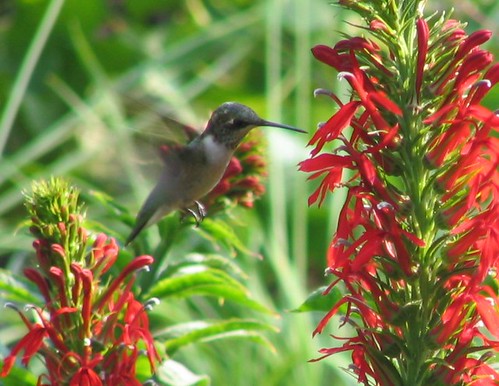
I used to love cardinal flower just because it's a gorgeous flower. It took a few years before I realized that if you sit quietly for long enough by a large patch, a hummingbird will come by. And that takes it to another level.

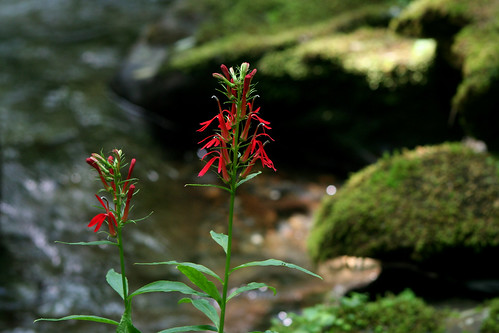
Lobelia cardinalis has brilliant, deep red flowers. In his book Wildflowers: A Guide to Growing and Propagating Native Flowers of North America, William Cullina describes them like this:

It is as if the flowers catch sunlight inside some sort of secret crystal matrix and let it bounce around for a while until it has been stripped of all but the deepest, purest red imaginable. Then and only then is the light released to burn crimson into our corneas.I will never forget the first time I found one in the wild, just a single plant growing in a low area behind my house. I stood there stunned for about five minutes trying to fathom how such a magical thing had come there.

Chances are, if he stood longer than five minutes, Cullina saw other magical things. The flowers don't have much of a smell. But that brilliant red is mightily attractive not just to humans, but to hummingbirds and butterflies -- especially, I've noticed, to eastern black swallowtail butterflies. If you find a patch, sit a while and see who comes by. Nothing is ever foolproof, but almost every time I have tried it, I have seen one or the other within twenty minutes. Just last week, a hummingbird started coming regularly last week to the patch of cardinal flowers in our yard, for the third year in a row.

Cardinal flowers bloom in a long spike at the top of a stem that can grow up to 4 feet tall. The flowers are worth a close look: they're quite unusual. Plants in the genus Lobelia all have similar asymmetrical tubular flowers, with the tube slit along the upper side. The flower's five anthers are united around the style, forming a silvery-lavender point that itself almost glows against the red of the flowers.

In the wild:Cardinal flower loves wet areas; you'll see it growing along streams or ponds. It's not the most common flower, but if you keep an eye out in these areas you should be able to find some.

In your yard: Cardinal flower is a perfect choice for a rain garden that catches water off your roof or any other wet spot in your yard. It can also be planted in normal, non-wet garden soil, especially with more shade -- it won't thrive during a drought, and it may not form as abundant a patch as it would with water, but it should do just fine. It's fairly easy to start from seed -- but be careful, the seeds are tiny!

Do you know a good cardinal flower patch? Any questions or observations? Leave a comment.

Like the photos in this post? Mouse over for credits; a click takes you to the photographer on Flickr.

Thursday, July 16, 2009

LOOK FOR: Wineberries

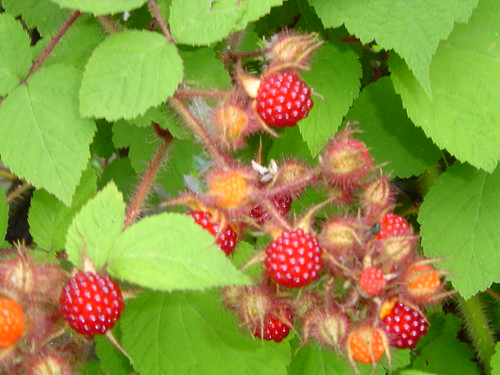
We're generally opposed to the Asian plants that have made it into our local woods, but the wineberry (Rubus phoenicolasius) might be one exception. For several weeks in July, these relatives of our native raspberries are abundant and delicious. And, if we can get to the berries before the birds do, and keep the plants from spreading, all the better. Get out there and do your part!

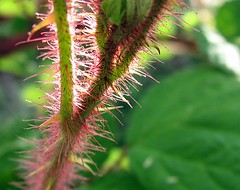
You've probably seen wineberries in the woods, but you may not have known what they were. Like other raspberries, wineberries grow on canes that grow up, then arch over to root and start another plant. With this growth habit, they can create large thickets. Unfortunately, their stems are covered in pinkish bristles -- they can give you quite a scratch if you're not careful. All raspberries have leaves of three, but those prickles are a key distinguishing characteristic that will help you tell the difference between wineberries and poison ivy (which has smooth stems). In addition, the undersides of the leaves are much whiter underneath than on top.

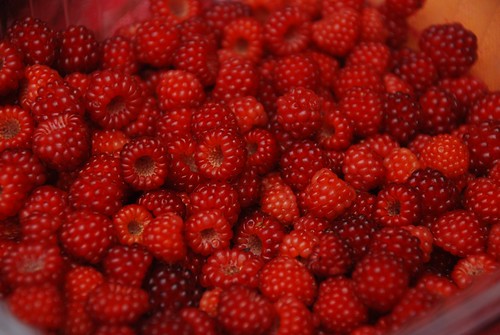
But at this time of year, the give-away is the clusters of red berries. They are shiny -- each one is like a collection of little glass balls. Wineberries darken and sweeten as they get riper. In general, though, even when they're very ripe, they're a little tarter than cultivated raspberries. For the sweetest berries, you want the ones that fall right off when you go to pick them, leaving behind the cone-shaped receptacle that they were growing on. Be gentle with them -- they can crush easily.

In the wild: The two most abundant wineberry spots we know of are along the C&O Canal near Chain Bridge, and Seneca Creek State Park in Gaithersburg (Matt will be leading a wild edibles hike there on August 1 -- let's hope the berries are still producing!). But they are scattered throughout other parks as well.

In your yard: Try planting a native raspberry, like the black raspberry, Rubus occidentalis. It ripens a little earlier (ours started in mid-June) and the flavor is sweeter. We love them both, but the blackcaps could use all the help they can get against the invasive wineberries.

Thursday, July 2, 2009

LOOK FOR: Common Milkweed

Milkweed is a beautiful, once-common roadside plant that is struggling in modern times. If you love monarch butterflies, you should show milkweed some love. Their lives depend on it: monarch larvae can only survive by eating milkweed leaves.

In June, common milkweed starts to form clusters of green balls -- the flower buds. And later in the month, these buds burst open into showy balls of tubular pink flowers. At 3-6 feet tall, with multiple flower clusters per stalk, this can be a very showy plant. On the few occasions I've come across a really large field of common milkweed, I've been intoxicated by the fragrance and the multitudes of pollinators dancing about. It's a lovely way to spend an afternoon.

There are many species of milkweed in the genus Asclepias. All share the property that when you break a leaf or stem of the plant, a white latex oozes out. (A 3-year-old friend recently tried to explain to me how cows get this "milk" into the milkweed, but I didn't quite follow it all.) Common milkweed, Asclepias syriaca, apparently got its scientific name through a botanical mix-up in the 1600's with a plant from the middle east (thus the Syrian epithet). Actually, this plant is all-American, and widespread east of the Rockies.

But not as widespread as it once was. Development and roadside mowing have dramatically reduced the milkweed available for hungry monarch caterpillars. Though logging in the monarchs' Mexican wintering grounds gets more attention, they also have less and less habitat for raising young here in the north every summer. Some states have started to catch on that by mowing roadsides just once or twice a year in spring and fall, they can save money and help wildlife at the same time. Let's hope this trend spreads.

In addition to supporting monarchs and many other pollinators, common milkweed was a staple plant for many Native Americans. At this time of year, the flower buds (pictured to the right) can be cooked much like broccoli. However, if you are going to eat milkweed, it is important to learn to distinguish it from poisonous dogbane (Apocynum cannabinum, aka indian hemp), which can look similar (same height, milky sap but less of it, similar shaped leaves but smaller). Dogbane has different flowers and no fuzz on the stem or undersides of the leaves as milkweed has. The most important difference is that dogbane is very bitter, while milkweed should taste like a sweet green vegetable. It really is quite good.

In the wild: Milkweed likes the sun -- look around unmowed open fields, power line clearcuts, and roadsides. For those of you around Takoma Park, there's quite a bit growing downhill from the track at Takoma Middle School, making a valiant stand against the invasive kudzu and porcelain berry.

In your yard: Common milkweed isn't recommended for yards because it can spread quite aggressively by underground roots. If you have an area like a street box that is self-contained it might work well there. Otherwise, try a less aggressive species, like swamp milkweed (Ascelpias incarnata) or butterflyweed (Asclepias tuberosa). Monarch larvae can survive on any species of Asclepias, and we've found them on both of these in our yard. Both are beautiful -- and likely to be the subject of future posts!