
Showing posts with label June. Show all posts

Thursday, July 2, 2009

LOOK FOR: Common Milkweed

Milkweed is a beautiful, once-common roadside plant that is struggling in modern times. If you love monarch butterflies, you should show milkweed some love. Their lives depend on it: monarch larvae can only survive by eating milkweed leaves.

In June, common milkweed starts to form clusters of green balls -- the flower buds. And later in the month, these buds burst open into showy balls of tubular pink flowers. At 3-6 feet tall, with multiple flower clusters per stalk, this can be a very showy plant. On the few occasions I've come across a really large field of common milkweed, I've been intoxicated by the fragrance and the multitudes of pollinators dancing about. It's a lovely way to spend an afternoon.

There are many species of milkweed in the genus Asclepias. All share the property that when you break a leaf or stem of the plant, a white latex oozes out. (A 3-year-old friend recently tried to explain to me how cows get this "milk" into the milkweed, but I didn't quite follow it all.) Common milkweed, Asclepias syriaca, apparently got its scientific name through a botanical mix-up in the 1600's with a plant from the middle east (thus the Syrian epithet). Actually, this plant is all-American, and widespread east of the Rockies.

But not as widespread as it once was. Development and roadside mowing have dramatically reduced the milkweed available for hungry monarch caterpillars. Though logging in the monarchs' Mexican wintering grounds gets more attention, they also have less and less habitat for raising young here in the north every summer. Some states have started to catch on that by mowing roadsides just once or twice a year in spring and fall, they can save money and help wildlife at the same time. Let's hope this trend spreads.

In addition to supporting monarchs and many other pollinators, common milkweed was a staple plant for many Native Americans. At this time of year, the flower buds (pictured to the right) can be cooked much like broccoli. However, if you are going to eat milkweed, it is important to learn to distinguish it from poisonous dogbane (Apocynum cannabinum, aka indian hemp), which can look similar (same height, milky sap but less of it, similar shaped leaves but smaller). Dogbane has different flowers and no fuzz on the stem or undersides of the leaves as milkweed has. The most important difference is that dogbane is very bitter, while milkweed should taste like a sweet green vegetable. It really is quite good.

In the wild: Milkweed likes the sun -- look around unmowed open fields, power line clearcuts, and roadsides. For those of you around Takoma Park, there's quite a bit growing downhill from the track at Takoma Middle School, making a valiant stand against the invasive kudzu and porcelain berry.

In your yard: Common milkweed isn't recommended for yards because it can spread quite aggressively by underground roots. If you have an area like a street box that is self-contained it might work well there. Otherwise, try a less aggressive species, like swamp milkweed (Ascelpias incarnata) or butterflyweed (Asclepias tuberosa). Monarch larvae can survive on any species of Asclepias, and we've found them on both of these in our yard. Both are beautiful -- and likely to be the subject of future posts!

Thursday, June 25, 2009

LOOK FOR: Ramp Flowers

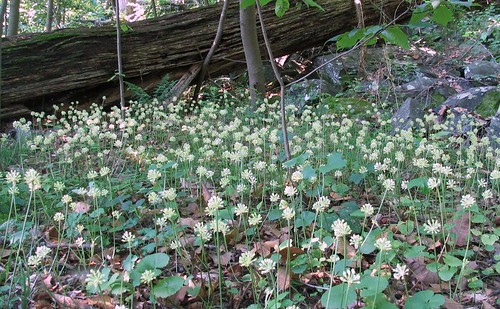
Ramps are well-known in the Appalachians as a sign of spring. When their broad green leaves emerge in April, there are ramp festivals throughout the region, as people cook up the roots and leaves. A member of the genus Allium, ramps are closely related to garlic and onions -- and are often called wild leeks.

By early June, the leaves have completely disappeared -- they can't photosynthesize much once the trees block their light. But right around now, where the leaves once were, you'll see a single stalk (about 6-8 inches tall) with a pompom of white flowers on top. As they mature, each of the small flower stalks on top will dry and remain in place. In the fall and winter, these dried pompoms stand out even when all other signs of the plant have disappeared -- especially if they still have the shiny black seeds at their tips. (The species name, Allium tricoccum, refers to the three seeds produced by each flower.)

Doug Elliot gives this interesting factoid about ramps in his book Wild Roots:
Because of their strong odor, Ramps were called pikwute sikakushia (the skunk) in the language of the midwestern Menomini Indians. Rich woodlands near the southern end of Lake Michigan were said to be a favorite Ramp gathering area, for which reason they called this area shikako, (the skunk place). This is where the fuming, seething, metropolis, now known as Chicago, gets its name.
Skunky or no, many wild food enthusiasts say ramps are tastier than any cultivated allium.

In the wild: Ramps are associated with the mountains, but they do grow in the wild along the Potomac -- perhaps the seeds have washed downstream. They grow in profusion at Scott's Run. We also have seen them on an island off the C&O Canal.

In your yard: You'll want a shady spot with rich soil. I'm not aware of nurseries that sell them, but you could try collecting seed in the fall and see if you can get them to come up. They will need to be in the cold outdoors over the winter, just like they would be in the wild. And some may take more than a year before they germinate. But it's worth a try!

Ramps

Thursday, June 18, 2009

LOOK FOR: Tiger Swallowtails

DC may be erupting in flowers, but there's something about seeing my first tiger swallowtail that makes me feel like it's really spring. In the fall, tiger swallowtails will form a chrysalis in which they'll spend the whole winter, waiting for the right time to emerge. And then, on some warm, sunny day in April or May, you'll see one fluttering by. And you'll know: winter's really over. In June, you'll start to see more. Summer's here.

Tiger swallowtails are large butterflies (they can have a wingspan up to 6 inches), and their black-and-yellow pattern is hard to miss. They have slightly different markings depending on whether they're male or female. The female has more blue on its bottom wings; males have little to no blue. (Just remember, blue is for...girls.) It must be this blue that Linneus was referring to when he gave this butterfly its species name, Papilio glaucus: "glaucus" can mean cerulean blue.

Remarkably, females can also be almost entirely black. There is some speculation that this might be mimicry of the pipevine swallowtail, which is much rarer in the DC area. It's also easy to confuse the black form of female tiger swallowtails with other black-colored swallowtails, such as the spicebush and black swallowtails. If you compare the two pictures on the right of the post, you'll see the edges of the wings are almost identical, but the blue is less pronounced. (Spicebush swallowtail has light blue, not yellow, spots on the edges of the wings; black swallowtail has more yellow on the wings.) They're all lovely.

In your yard: To attract tiger swallowtails temporarily, plant nectar flowers. But to really support them, plant one of their host plants -- which will provide the leaves the caterpillars need to eat. These include several trees; black cherry and tuliptree are favorites.

In the wild: You'll see tiger swallowtails in both woods and open fields. We've noticed they like to fly over trails and streams, perhaps because there are fewer obstacles. They sometimes will "puddle" in a sunny, muddy area, where they absorb minerals from the mud.

Sources for this post:

Thursday, June 11, 2009

LOOK FOR: Fireflies

One night many years ago I looked out over a field dancing with fireflies and I had a realization: this is why people believed in fairies. I must have been thinking of Disney's Tinkerbell and her trail of twinkling pixie dust, so much like the swooping, twinkling light of the fireflies. Or J.M. Barrie's description: "when the first baby laughed for the first time, its laugh broke into a thousand pieces, and they all went skipping about, and that was the beginning of fairies."

But those dancing lights aren't fairies. They aren't flies, either: they're beetles, actually. In the light of day, they look like nothing special: black beetles, sometimes with a red head. The exact looks of a firefly depends on the species; there are 23 genera and about 200 species of fireflies in North America.

The different species also have different flashing patterns at night. (The Museum of Science, Boston, has an animation that shows what to look for to tell the difference.) Some come out at dusk; others wait for more darkness. Some are high in the trees; others are closer to ground level. They also may flash different numbers of times, with different duration, and flying in different patterns while they flash. That way, they only seek mates of their own species. Unless, that is, they've been tricked by an impostor in the genus Photuris, which mimics the flashing patterns of other fireflies to lure them in and eat them.

When they're done mating, female fireflies lay their eggs in the ground or in rotting logs. The larva of a firefly looks like a grub, and eats other insects, as well as worms, snails and slugs. The larvae -- and the eggs -- can glow in the dark. This gives the family of fireflies their name: Lampyridae, from the Latin and Greek words for "glowworm." One theory is that the green glow is a warning sign to predators that these larvae don't taste good. Apparently, the adults don't taste good either.

But humans don't care what they taste like. And so we like the dancing green glow: as a sign of summer, as a memory of childhood. Or as a glimmer of hope that fairies really do exist, if we only believe.

In the wild: Different species like different habitats, but a good bet is to look at the edge between forest and open field. They also seem to like to be near a source of water. The picnic areas at Rock Creek Park are probably ideal.

In your yard: Even when we lived in a 6th floor condo in Dupont Circle, we could see fireflies in the street trees. But there are some things you can do to help attract and protect fireflies in your yard, if you have one:
  1. Habitat. Because they spend a lot of time on the ground during the day, fireflies may be harmed by lawn mowing. In addition, lawn pesticides aimed at grubs may kill firefly larvae, which also live in the soil. This is just one more reason it makes sense to avoid spraying your lawn, and let it grow to at least 3 inches before cutting. Better yet, consider replacing some lawn with plants that do not need to be mowed.
  2. Darkness. Some scientists think outdoor lights and streetlights may interfere with fireflies' ability to communicate and find mates. You may have a better show if you leave your outdoor light off.
  3. Research. The Museum of Science, Boston asks people to report their observations of fireflies once a week throughout the summer, to learn more about firefly distribution and behavior. Sign up at Firefly Watch.
Also this week:
The mulberries are still dropping, but honestly, with all this rain, they're pretty tasteless. The serviceberries are probably also still going.

Sources for this post:
Firefly.org
Museum of Science, Boston

Have you started seeing fireflies yet? Do you have a favorite place to watch them? Leave a comment.

Thursday, June 4, 2009

LOOK FOR: Serviceberries

serviceberry, amelanchier, juneberry
Photo credit: dbarronoss
When people ask us what kind of flowering tree they should plant in their yard, Matt has lots of nuanced answers. I almost always say: a serviceberry. White flowers in the spring, tasty fruits for you and the birds in June, fall foliage, and often a nice multi-stemmed growing habit...what's not to love?

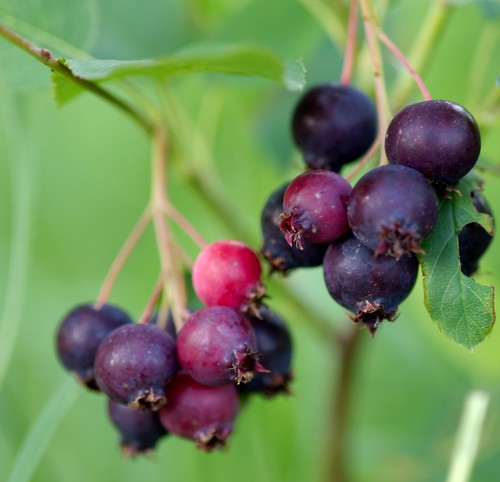
But whether you have a yard or not, now is the time to look for the berries. They're smaller than a typical cultivated blueberry, but they have the same sepals on the bottom. As they ripen, they turn from magenta to a dark purple. Serviceberries were widely used as a food by Native Americans, and George Washington planted several at Mount Vernon. But they don't ship well, so they've never taken off as a commercial fruit.

Serviceberries go by many names, and each name has a story. The story I have heard related to the "service" is that they bloom around the time the ground thaws in the spring, and so were associated with the funeral services that happened when graves could first be dug (other authors say it's a corruption of "sarvisberry," a reference to the European mountain ash). Around the same time of year, shad (a type of saltwater fish) come up rivers to spawn, and so serviceberry is also known as shadbush. The name we first learned for serviceberry was Juneberry; this may be more or less accurate depending on your latitude and elevation. Then there's the Latin genus name: Amelanchier, which comes from the French amelanche, an old word for a small apple.

There are several species within the genus; native to this area are canadensis, laevis, and arborea. But, William Cullina writes, "They freely interbreed where ranges overlap, creating a vast and notorious hybrid swarm that has driven sober botanists to drink. You really never know for sure what you are going to get." We're usually just happy to know we're looking at an Amelanchier.

serviceberry, amelanchier, juneberry
Photo credit: ocean des etoiles
In the wild: Serviceberries are scattered through the woods here; they're an understory tree that's rarely more than 2o feet tall, but can reach 40 feet. It may be easier to find some of the ornamental plantings we're aware of: to start with, a few at the corner of Carroll and Laurel in Takoma Park; several large trees at the Lowell School on the edge of Rock Creek Park; and several in the 1600 block of Corcoran St. NW in DC. The densest population of serviceberries we have ever seen is in the Dolly Sods area of Monongahela National Forest, but they won't be ripe there until July or August.

In your yard: Yes, please. Local nurseries carry them in stock. Different species and cultivars have different characteristics (e.g., single stem vs. multi-stem), so be sure you know what you're getting if you have a preference. In general, serviceberries will flower and set fruit better with some sun, but they can also take shade.


Where else have you found serviceberries? Leave a comment if you're willing to give away your spot!

Thursday, May 28, 2009

LOOK FOR: Mulberries

In early- to mid-June, you are likely to start noticing purple bird droppings everywhere. You will also see a select group of people in-the-know with telltale purple stains on their fingertips. The culprit: mulberries.

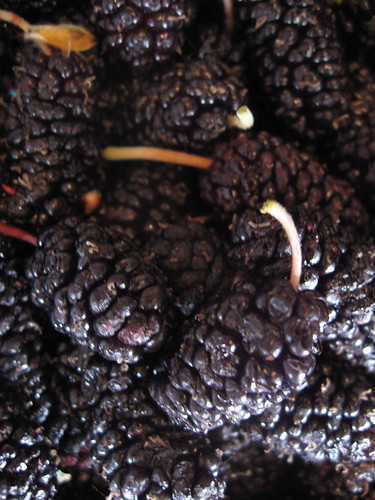
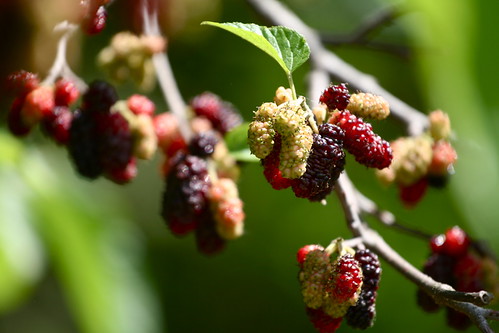
Morus rubra is a native tree related to the Asian mulberry trees (morus alba) used to raise silkworms. In fact, you'll find both growing in this area, because at some point there was an attempt to establish a silk industry on the East Coast. Rubra berries darken from white to red to a deep purple as they ripen. Alba berries remain white but get softer when ripe. Despite their different continents of origin, the two species are closely enough related that you may also see hybrid trees with fruits that are mixed colors or a lighter purple when ripe.

Both species of mulberries are edible, and they're hard to confuse with anything else: there aren't any other local trees bearing fruit that looks like this. The berries look like blackberries, but those grow on canes coming out of the ground, not on tree branches, and they won't come until later in the summer.

Mulberries can be used like other berries: they can be eaten raw or cooked into cobblers, pies, jams, or any other fruit recipe. The flavor of mulberries is much less tart than many other berries, so you may find you like them better with a little lemon juice or mixed with another fruit. As with many fruits, unripe berries can make you sick. You want berries that are soft, and dark purple.

One good way to spot a tree with ripe mulberries is that the fruit will start falling to the ground: if you see purple spots on the sidewalk or street, look up and you're likely to see fruit on the branches as well. This tendency of the fruit to fall when ripe leads to an easy way to harvest large quantities: put a tarp or a sheet on the ground and shake the branches over it. You'll have to sort through the assorted bits and pieces that fall down, but it's still much faster than picking individual berries.

In the wild: Actually, you're most likely to spot this tree in residential neighborhoods, especially along fences where birds have sat after eating mulberries. Most homeowners will be more than happy to have you take some of their berries before they fall on the ground and make a mess. There are some along the paved path in the Peirce Mill area of Rock Creek Park.

In your yard: Because of the aforementioned mess of dropping fruits, most homeowners avoid planting this tree. On the other hand, you and the birds will both be well-fed, and they grow like weeds. The native morus rubra grows to about 40 to 70 feet, so make sure you have enough space before planting.

Sources for this post:
Euell Gibbons, Stalking The Wild Asparagus
Steve Brill, Identifying and Harvesting Edible and Medicinal Plants in Wild (and Not So Wild) Places