
Showing posts with label Plants - June. Show all posts

Thursday, June 25, 2009

LOOK FOR: Ramp Flowers

Ramps are well-known in the Appalachians as a sign of spring. When their broad green leaves emerge in April, there are ramp festivals throughout the region, as people cook up the roots and leaves. A member of the genus Allium, ramps are closely related to garlic and onions -- and are often called wild leeks.

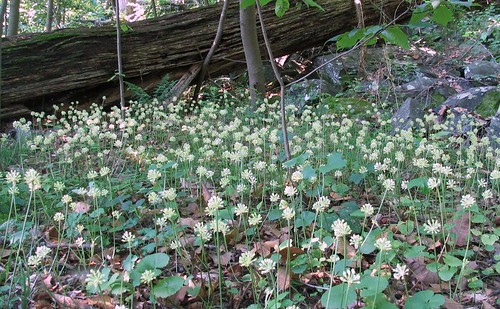
By early June, the leaves have completely disappeared -- they can't photosynthesize much once the trees block their light. But right around now, where the leaves once were, you'll see a single stalk (about 6-8 inches tall) with a pompom of white flowers on top. As they mature, each of the small flower stalks on top will dry and remain in place. In the fall and winter, these dried pompoms stand out even when all other signs of the plant have disappeared -- especially if they still have the shiny black seeds at their tips. (The species name, Allium tricoccum, refers to the three seeds produced by each flower.)

Doug Elliot gives this interesting factoid about ramps in his book Wild Roots:
Because of their strong odor, Ramps were called pikwute sikakushia (the skunk) in the language of the midwestern Menomini Indians. Rich woodlands near the southern end of Lake Michigan were said to be a favorite Ramp gathering area, for which reason they called this area shikako, (the skunk place). This is where the fuming, seething, metropolis, now known as Chicago, gets its name.
Skunky or no, many wild food enthusiasts say ramps are tastier than any cultivated allium.

In the wild: Ramps are associated with the mountains, but they do grow in the wild along the Potomac -- perhaps the seeds have washed downstream. They grow in profusion at Scott's Run. We also have seen them on an island off the C&O Canal.

In your yard: You'll want a shady spot with rich soil. I'm not aware of nurseries that sell them, but you could try collecting seed in the fall and see if you can get them to come up. They will need to be in the cold outdoors over the winter, just like they would be in the wild. And some may take more than a year before they germinate. But it's worth a try!
Ramps

Thursday, June 4, 2009

LOOK FOR: Serviceberries

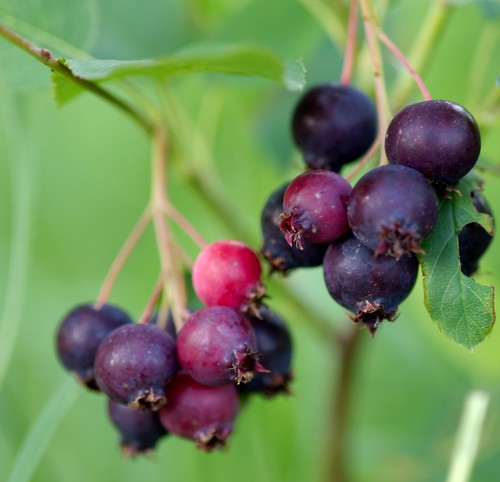
serviceberry, amelanchier, juneberry
Photo credit: dbarronoss
When people ask us what kind of flowering tree they should plant in their yard, Matt has lots of nuanced answers. I almost always say: a serviceberry. White flowers in the spring, tasty fruits for you and the birds in June, fall foliage, and often a nice multi-stemmed growing habit...what's not to love?

But whether you have a yard or not, now is the time to look for the berries. They're smaller than a typical cultivated blueberry, but they have the same sepals on the bottom. As they ripen, they turn from magenta to a dark purple. Serviceberries were widely used as a food by Native Americans, and George Washington planted several at Mount Vernon. But they don't ship well, so they've never taken off as a commercial fruit.

Serviceberries go by many names, and each name has a story. The story I have heard related to the "service" is that they bloom around the time the ground thaws in the spring, and so were associated with the funeral services that happened when graves could first be dug (other authors say it's a corruption of "sarvisberry," a reference to the European mountain ash). Around the same time of year, shad (a type of saltwater fish) come up rivers to spawn, and so serviceberry is also known as shadbush. The name we first learned for serviceberry was Juneberry; this may be more or less accurate depending on your latitude and elevation. Then there's the Latin genus name: Amelanchier, which comes from the French amelanche, an old word for a small apple.

There are several species within the genus; native to this area are canadensis, laevis, and arborea. But, William Cullina writes, "They freely interbreed where ranges overlap, creating a vast and notorious hybrid swarm that has driven sober botanists to drink. You really never know for sure what you are going to get." We're usually just happy to know we're looking at an Amelanchier.

serviceberry, amelanchier, juneberry
Photo credit: ocean des etoiles
In the wild: Serviceberries are scattered through the woods here; they're an understory tree that's rarely more than 2o feet tall, but can reach 40 feet. It may be easier to find some of the ornamental plantings we're aware of: to start with, a few at the corner of Carroll and Laurel in Takoma Park; several large trees at the Lowell School on the edge of Rock Creek Park; and several in the 1600 block of Corcoran St. NW in DC. The densest population of serviceberries we have ever seen is in the Dolly Sods area of Monongahela National Forest, but they won't be ripe there until July or August.

In your yard: Yes, please. Local nurseries carry them in stock. Different species and cultivars have different characteristics (e.g., single stem vs. multi-stem), so be sure you know what you're getting if you have a preference. In general, serviceberries will flower and set fruit better with some sun, but they can also take shade.


Where else have you found serviceberries? Leave a comment if you're willing to give away your spot!

Thursday, May 28, 2009

LOOK FOR: Mulberries

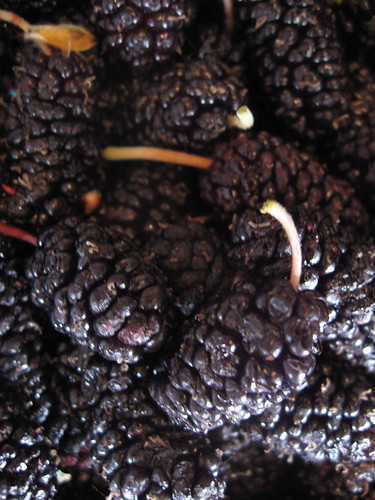
In early- to mid-June, you are likely to start noticing purple bird droppings everywhere. You will also see a select group of people in-the-know with telltale purple stains on their fingertips. The culprit: mulberries.

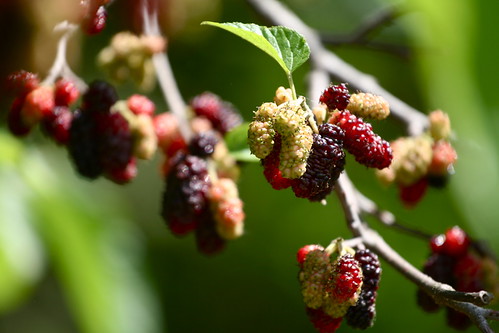
Morus rubra is a native tree related to the Asian mulberry trees (morus alba) used to raise silkworms. In fact, you'll find both growing in this area, because at some point there was an attempt to establish a silk industry on the East Coast. Rubra berries darken from white to red to a deep purple as they ripen. Alba berries remain white but get softer when ripe. Despite their different continents of origin, the two species are closely enough related that you may also see hybrid trees with fruits that are mixed colors or a lighter purple when ripe.

Both species of mulberries are edible, and they're hard to confuse with anything else: there aren't any other local trees bearing fruit that looks like this. The berries look like blackberries, but those grow on canes coming out of the ground, not on tree branches, and they won't come until later in the summer.

Mulberries can be used like other berries: they can be eaten raw or cooked into cobblers, pies, jams, or any other fruit recipe. The flavor of mulberries is much less tart than many other berries, so you may find you like them better with a little lemon juice or mixed with another fruit. As with many fruits, unripe berries can make you sick. You want berries that are soft, and dark purple.

One good way to spot a tree with ripe mulberries is that the fruit will start falling to the ground: if you see purple spots on the sidewalk or street, look up and you're likely to see fruit on the branches as well. This tendency of the fruit to fall when ripe leads to an easy way to harvest large quantities: put a tarp or a sheet on the ground and shake the branches over it. You'll have to sort through the assorted bits and pieces that fall down, but it's still much faster than picking individual berries.

In the wild: Actually, you're most likely to spot this tree in residential neighborhoods, especially along fences where birds have sat after eating mulberries. Most homeowners will be more than happy to have you take some of their berries before they fall on the ground and make a mess. There are some along the paved path in the Peirce Mill area of Rock Creek Park.

In your yard: Because of the aforementioned mess of dropping fruits, most homeowners avoid planting this tree. On the other hand, you and the birds will both be well-fed, and they grow like weeds. The native morus rubra grows to about 40 to 70 feet, so make sure you have enough space before planting.

Sources for this post:
Euell Gibbons, Stalking The Wild Asparagus
Steve Brill, Identifying and Harvesting Edible and Medicinal Plants in Wild (and Not So Wild) Places