
Showing posts with label May. Show all posts

Thursday, May 28, 2009

LOOK FOR: Mulberries

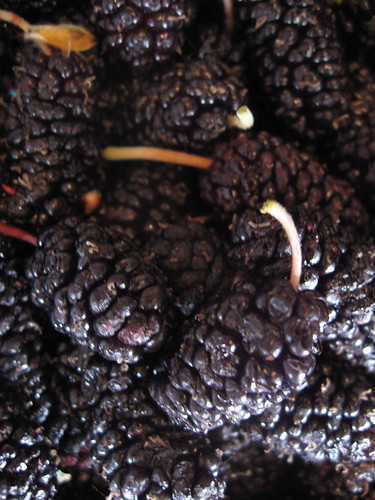
In early- to mid-June, you are likely to start noticing purple bird droppings everywhere. You will also see a select group of people in-the-know with telltale purple stains on their fingertips. The culprit: mulberries.

Morus rubra is a native tree related to the Asian mulberry trees (morus alba) used to raise silkworms. In fact, you'll find both growing in this area, because at some point there was an attempt to establish a silk industry on the East Coast. Rubra berries darken from white to red to a deep purple as they ripen. Alba berries remain white but get softer when ripe. Despite their different continents of origin, the two species are closely enough related that you may also see hybrid trees with fruits that are mixed colors or a lighter purple when ripe.

Both species of mulberries are edible, and they're hard to confuse with anything else: there aren't any other local trees bearing fruit that looks like this. The berries look like blackberries, but those grow on canes coming out of the ground, not on tree branches, and they won't come until later in the summer.
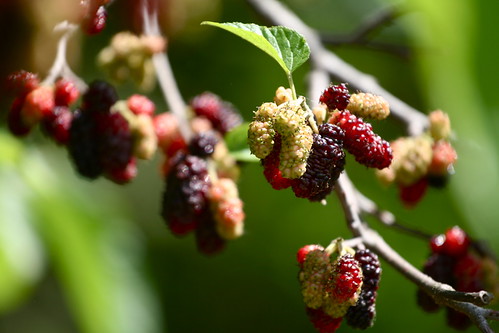
Mulberries can be used like other berries: they can be eaten raw or cooked into cobblers, pies, jams, or any other fruit recipe. The flavor of mulberries is much less tart than many other berries, so you may find you like them better with a little lemon juice or mixed with another fruit. As with many fruits, unripe berries can make you sick. You want berries that are soft, and dark purple.

One good way to spot a tree with ripe mulberries is that the fruit will start falling to the ground: if you see purple spots on the sidewalk or street, look up and you're likely to see fruit on the branches as well. This tendency of the fruit to fall when ripe leads to an easy way to harvest large quantities: put a tarp or a sheet on the ground and shake the branches over it. You'll have to sort through the assorted bits and pieces that fall down, but it's still much faster than picking individual berries.

In the wild: Actually, you're most likely to spot this tree in residential neighborhoods, especially along fences where birds have sat after eating mulberries. Most homeowners will be more than happy to have you take some of their berries before they fall on the ground and make a mess. There are some along the paved path in the Peirce Mill area of Rock Creek Park.

In your yard: Because of the aforementioned mess of dropping fruits, most homeowners avoid planting this tree. On the other hand, you and the birds will both be well-fed, and they grow like weeds. The native morus rubra grows to about 40 to 70 feet, so make sure you have enough space before planting.

Sources for this post:
Euell Gibbons, Stalking The Wild Asparagus
Steve Brill, Identifying and Harvesting Edible and Medicinal Plants in Wild (and Not So Wild) Places

Thursday, May 21, 2009

LOOK FOR: Mountain Laurel

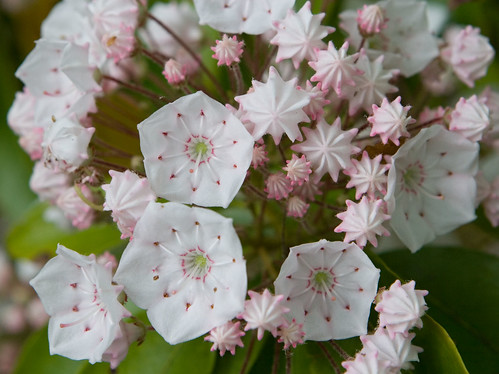
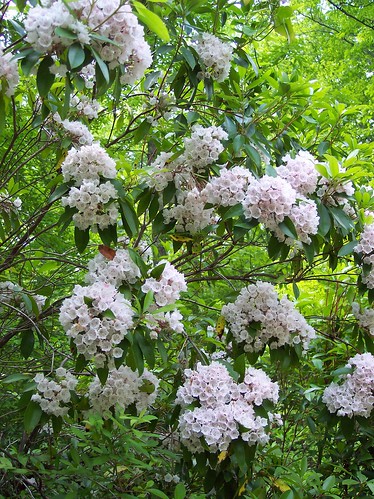
The gnarled, shaggy trunks of mountain laurel (Kalmia latifolia) make it a showy shrub at any time of year. It often grows in thickets -- long expanses of twisty branches that cover entire hillsides. And in late May or early June, those thickets burst into flower.

The buds of mountain laurels look like an old-fashioned candy. They open up into a cup-shaped flower made of five petals that are fused together. The flowers are usually a very faint pink, but you may see cultivated varieties with darker flowers.

They may look pretty, but mountain laurel flowers are quite sneaky. The ten stamens of each flower start out tucked into little dimples in the petals. As a bee lands on the flower, the stamens spring out of their dimples, releasing their pollen. Try springing the trap yourself, or sit and watch: a bee is sure to come along.

Mountain laurel is in the genus Kalmia, named after Peter Kalm, a Finnish-Swedish naturalist. Kalm came to North America in 1748 to look for plants that might have agricultural uses in Europe; he brought back hundreds of specimens. In writing about mountain laurel, Kalm described the uses that Native Americans and colonists had for the plant. The wood, while usually not thick, is strong, and was used for pulleys, spoons, and trowels; the leaves were used as a medicinal skin wash.

In the wild: There is a nice stand of mountain laurel in Rock Creek Park on the Valley Trail, north of Holly St., after you go up a big hill (map; previous post), and another on the Rachel Carson Greenway Trail along the Northwest Branch of the Anacostia, just north of Colesville Road (map; previous post). I'm sure there are others: keep an eye out on north-facing slopes, and post other sightings in the comments below.

In your yard: Mountain laurels can be hard to get established. They want very acidic soil that remains cool and moist. We've never had any luck getting one to survive, but we do know a few yards with successful plantings.

Sources for this post:
Richard Jaynes, Kalmia: Mountain Laurel and Related Species
William Cullina, Native Trees, Shrubs, and Vines: A Guide to Using, Growing, and Propagating North American Woody Plants


Thursday, May 14, 2009

LOOK FOR: Tuliptree Flowers

Tuliptrees are one of the dominant species in the forests in and around Washington, DC. But because the trees are so tall, many people have never seen their flowers. It's worth the effort to find them.

The latin name for tuliptree -- Liriodendron tulipifera -- is all about the flowers: it's a tulip-bearing lily-tree. And with good reason. If they're within reach, the flowers are large and showy -- about 2-3 inches long and shaped like a tulip. The mostly-green petals are set off by an orange stripe. The stamens and pistils are thick, and arranged around a central spike like a magnolia flower; tuliptrees are actually in the magnolia family.

If your timing is right, you can get a special treat. Tuliptrees produce more nectar than any other plant in North America, about a third of a teaspoon per flower. Doug Elliott told us this fact one summer, after the flowers were done for the year. We mostly forgot about it -- until one spring day the next year, when we saw droplets collected on some understory shrubs. This was odd, since it was 3:00 in the afternoon on a sunny day. Sure enough, there was a tuliptree rising high above. So we gave the droplets a tentative taste. Wow! Pure concentrated sweetness. We spent the rest of the afternoon looking for more nectar droplets in the shrubbery, and hit the jackpot when we came to a recently-downed tree: all of the flowers that managed to bloom were conveniently at ground level.

Tuliptrees (also known as tulip poplar, but they're not really a poplar) have been known to live to 400 years old, reaching heights of 198 feet and a diameter of 10 feet. We don't have any that big around here -- the old-growth trees were all logged long ago. But the tuliptrees are still some of the tallest trees around. They tend to grow straighter than most of our other local trees, which makes them easy to spot in the forest; it also made them a tree of choice for dugout canoes. The leaves are also distinctive: one of the only leaves that doesn't come to a single point at the end, they also remind some people of tulips.

In your yard: If you want to plant a tuliptree, make sure you've got space for it. If you do, you'll be doing future generations a favor. Tuliptrees want sun -- they're a canopy tree -- but eventually, they'll provide great shade for your house and yard.

In the wild: You'll find tuliptrees in most woods in the DC area. To get a glimpse of the flowers, you have a few options. Some trees growing on forest edges do have branches low enough to see. Otherwise, try looking from one of the bridges that crosses Rock Creek Park, or from bluffs along Rock Creek or along the Potomac. Also keep an eye out on the forest floor when they start to drop -- that's how I saw my first tuliptree flower.

Thursday, May 7, 2009

LOOK FOR: Pinxter Azaleas

The DC area is full of azaleas. Some yards are an absolute riot of hot pinks and purples right now -- mostly with azaleas bred from Asian species. But there is actually an azalea native to this area, and it's quite showy in its own right.

Pinxter (or Pinxterbloom) azalea, Rhododendron periclymenoides, has a looser habit than typical cultivated azaleas, and its light pink blooms are a little sparser. But the blooms are incredibly showy, with long stamens and an even longer pistil that swoop out far beyond the petals. You can tell it's going for the large pollinators: butterflies and hummingbirds.

The name Pinxter actually doesn't come from the color of the flower; it comes from the Dutch word for Pentecost. In this area, the flowers may be looking a little ragged by Pentecost (50 days after Easter). It all depends on the weather and on where Easter falls on the calendar in any given spring. I suspect in New York, where the Dutch settlers who gave the name were presumably observing it, the slightly later growing season makes it a perfect name.

In your yard: Pinxters lose their leaves over the winter, unlike the asian azaleas -- probably a key reason that they're not popular as a landscape plant. But we think they're worth growing. The pinxter we planted here at Natural Capital headquarters (aka our back yard) struggled for the first year after we planted it, but is blooming nicely this year. Like all azaleas, they want acidic soil. Try a spot with light shade; you want enough light to encourage blooms, but plenty of protection from the summer heat.

In the wild: There are several pinxters along the Valley Trail in the northern part of Rock Creek Park, like the one pictured to the left. Our favorite is on a bluff looking over the creek north of Holly St.

Sources for this post:

Bookmark and Share