

Showing posts with label DC. Show all posts

Tuesday, January 26, 2010

Rainy Day Nature: Planetariums in the DC Area

Some friends of ours are making an effort to learn a little astronomy, since their four year old seems to be taking a natural interest in the stars and planets (hi Solomon!). But it's awfully chilly to be outside at night right now, even if the darkness does start nice and early. Which led us to say, hey, aren't there a couple of planetariums around DC? Turns out, there's more than a couple.

illustration outside the Rock Creek Park planetariumWe've been to the one in the Rock Creek Nature Center (5200 Glover Road, NW; 202-895-6070). It's a small 75-seat space but the rangers do a nice job of putting together a variety of programs. In general, they have the following schedule of 45-60 minute, age-rated shows (check this week's exact topics here):
  • Saturdays and Sundays at 1:00: ages 5+
  • Saturdays and Sundays at 4:00: ages 7+
  • Wednesday afternoons at 4:00: ages 4+
Tickets to Rock Creek Planetarium shows are free and can be picked up at the information desk in the Nature Center a half hour before the show.

einstein planetarium ticketsThere's also the Einstein Planetarium at the Air and Space Museum (1-877-932-4629). With a 70-foot dome and 233 seats, it's a totally different experience from the planetarium at Rock Creek Park. Their website touts that "you'll feel the sensation of zooming through the cosmos, enveloped in color saturated moving images and spine-tingling sound." They offer 25 minute shows every half hour, from 11:00 to 5:00.  Tickets for these shows are $8.75 for adults, $7.25 for youth. But there are also FREE shows at 10:30 AM on selected days, including Saturdays (see schedule).

In addition to the two planetariums we knew about, we were surprised to discover that several local school systems have planetariums. These are used primarily for school groups, but also offer programs for the public. 

Prince George's Howard B. Owens Science Center in Lanham (9601 Greenbelt Road; 301-918-8750) has a 55-foot dome with 174 seats -- the largest planetarium in Maryland. Public programs are on the first Friday of every month during the school year. Tickets are $4 for adults and $2 for students and seniors. (Power Point slide of this spring's programs here.)

Arlington's 70-seat David M. Brown Planetarium (1426 N. Quincy St.) offers a kid-oriented public program on Friday and Saturday evenings and Sunday afternoons during the school year (it appears to be the same show every time; see schedule).  They also hold a program on the first Monday of the month that focuses on the current night sky and includes an interactive talk with the planetarium director, followed by the opportunity to use outdoor telescopes if weather permits. Tickets for all events are $3 for adults, $2 for children and seniors.

At 24 feet wide and just 42 seats, the Montgomery College planetarium (about 7651 Fenton Street; see directions) is pretty tiny. But it was an exciting find, since it's right down the street from us! It's open to the public for free shows once a month or so during the academic year, on Saturday nights at 7:00 (see schedule). Compared to several other planetariums, the show topics appear to be more adult-oriented (Space-Time Invariance and Quantum Gravity, anyone?). Shows are followed by the opportunity to use telescopes outdoors, weather permitting.

Even smaller, the Alexandria planetarium at TC Williams High School (3330 King St., 703-824-6805) has just 35 seats available, so they require advance registration for their monthly hour-long shows (see schedule).

Have you been to any of the shows at these planetariums? Leave a review in the comments section -- it'll take us a while before we make it to all of them!

Like the photos in this post? Mouse over for credits; a click takes you to the photographer on Flickr.

Tuesday, December 1, 2009

Rainy Day Nature: the National Aquarium in DC

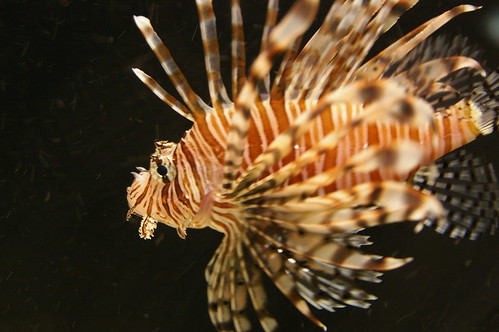
fish at the National AquariumDid you know there's an aquarium just off the mall, on 14th St.? Sure, it's nothing near the size of the Baltimore Aquarium. But it's closer, cheaper, and much less crowded.

The 250+ species at the National Aquarium are organized by ecosystem, highlighting the National Marine Sanctuaries of the US, major freshwater rivers, and the Amazon River. Highlights include alligators, beautiful tropical fish, pirahnas, some small sharks, poison dart frogs, and an invasive snakehead. Feedings are at 2:00 every day.

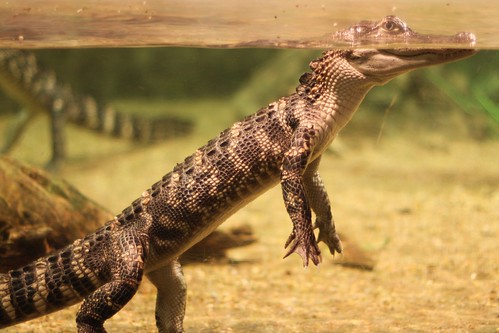
alligator at the National AquariumThe National Aquarium started in 1878 in some lakes by the Washington Monument. It moved around the Mall a few times until landing in the basement of the Commerce Building (then home of the Bureau of Fisheries) in 1932. In 1982, they lost their federal funding, and there have been some lean years. But in 2003, the aquarium affiliated with the Baltimore Aquarium, and they've since undergone a multi-million-dollar face-lift. It's definitely an improvement. So if you haven't been in a while, it might be worth another visit.

baby loggerhead at the National Aquarium
Hours: daily 9 AM to 5 PM (last admission at 4:30), except Christmas and Thanksgiving Day

Admission:
$7 for ages 11 and up
$3 ages 2-10
$6 seniors and military

Public Transportation: Federal Triangle is the closest metro station.

National Aquarium
14th and Constitution Avenue, NW
Washington, DC 20230

Like the photos in this post? Mouse over for credits; a click takes you to the photographer on Flickr.

Tuesday, November 24, 2009

Natural Places in the DC Area To Take Your Out-of-Town Visitors

If you're like us, you've got company coming for Thanksgiving. Some ideas on where to take your guests, for Thanksgiving or at any other time of the year:

Great Falls has always been our default guest-taking spot. There's really nothing like it in the DC area. The views of the falls are great from either side, though the Washington City Paper dubbed Cow Hoof Rock, on the Virginia side, as the best view of the Potomac last year. You have a choice of gentle trails (like the C&O Canal towpath in MD or the Swamp Trail in VA), or rugged trails (like the Billy Goat Trail in MD), for your guests to choose from. $5 admission.

Several Natural Capital readers said they take their guests to the National Arboretum. There's so much to choose from -- everything from very natural-looking and un-manicured Fern Valley, to an indoor bonsai exhibit with trees that have been maintained for hundreds of years. Plus the old Capital columns arranged to look like a Greek temple are a treat for architecture and history buffs.  The grounds are open every day from 8 to 5, but the bonsai exhibit is closed on Thanksgiving Day and open on other days only from 10 to 4, so plan accordingly. Free.

If you're going to be down on the Mall, make a detour from all the museums to the US Botanic Garden. Even if you just pop in for a few minutes to see the orchid exhibit, your guests will be impressed. Plus, starting on Thanksgiving, they have a toy train that goes through landscapes and buildings made of sticks, seeds, and other plant-based materials, along with a giant Christmas tree and lots of poinsettias. Free.

Thanksgiving bonus: Take 'em to Turkey Run. Not just for the name -- though that's while we suggest it -- but because it's a pretty spot on the Potomac, where you'll have to climb hills. And we suspect you'll have a few extra calories you'll be wanting to work off this weekend. Free.

Tuesday, November 10, 2009

Rainy Day Nature: The Conservatory of the US Botanic Garden

When I worked on the Mall, the Conservatory of the US Botanic Garden was a key part of my winter survival strategy. If you need a fix of green growing things, or of warm, steamy air, this is your place.

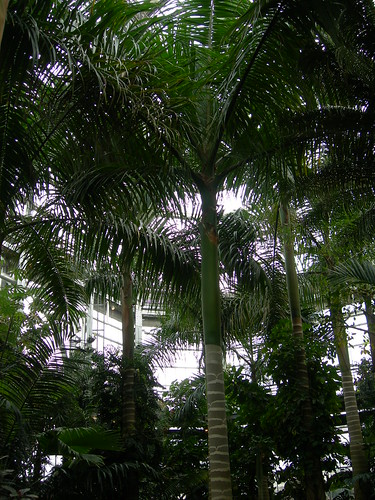
At any given time, there are about 4,000 plants on display in these Botanic Garden greenhouses. A major highlight for me is the orchid room.  Hundreds of orchids are on display at any given time, rotated in and out according to what's blooming. (The USBG's entire collection includes about 5,000 orchids.) What an amazing display of the wonders of evolution. Be sure to smell as well as look -- the white orchids are more likely to have stronger fragrance.


In the center of the Botanic Garden, under a 93 foot dome, is a display in which jungle plants are "overtaking an abandoned plantation." You can walk through the ground floor, or climb up to a balcony that views the canopy of these plants. Keep an eye out for bananas!

Other sections of the greenhouses reconstruct other environments. One room contains a reconstructed Jurassic landscape of ferns and other ancient plants. Another highlights cacti, succulents, and other flora from deserts around the world. A Hawaii room shows off plants from that tropical paradise. (Do you see why I find this place restorative in the winter?)


For those looking for a human connection, other displays highlight the uses of specific plants: as medicines, and as fibers, food, cosmetics, and other economic goods. And there is an exhibit on the role of plants in culture.


The human history of the garden itself is also interesting. Apparently, George Washington, Thomas Jefferson, and James Madison all participated in calls to have a national botanic garden. One was established on the Mall in 1820, and this one has been in  continuous operation since 1850. The current structure dates to 1933, and is under the jurisdiction of the Architect of the Capitol -- making the Botanic Garden part of the Legislative Branch.


Admission to all public areas of the U.S. Botanic Garden is free. The Conservatory is open 10 AM to 5 PM daily, including weekends and holidays, with free tours on Mondays and Thursdays at noon. The closest metro is Federal Center SW.

US Botanic Garden
100 Maryland Avenue, SW
Washington, DC 20001

Like the photos in this post? Mouse over for credits; a click takes you to the photographer on Flickr.
Tuesday, August 11, 2009

Car-free DC: Glover Archbold Park

This is the eighth article in a series on hikes in DC that can be reached by public transportation.

Glover-Archbold (not Archibold, nor Archibald, I've just discovered) is a long, narrow park that follows Foundry Branch from Van Ness Street in Tenleytown to Canal Road, just west of Georgetown University. It's yet another green oasis in the middle of our fair city -- and less well-known than many other parks. And with its proximity to Georgetown, you may get in some celebrity sightings as well -- I once saw Madeline Albright hiking here with her Secret Service detail.

According to folks at the DC Audubon Society, the most interesting birding section of Glover-Archbold is just north of Reservoir Road -- perhaps because the stretch between here and Fulton St. is the widest section of the park.

There are several points in the park that are easily accessible by public transportation. You can follow along on this Park Service map, which covers both Rock Creek Park and Glover Archbold. From north to south:

Van Ness Street: From Tenleytown Metro station, head south on Wisconsin, then go right on Van Ness St. You'll be at the north end of the park.

Massachusetts Ave and Cathedral Ave: The N6 runs between Dupont Circle and Friendship Heights. Get off at Massachusetts and Macomb, then walk up Massachusetts to where the trail crosses the road. Or get off on Cathedral Ave. as it crosses the park.

Reservoir Road: The D6 from Farragut West and Dupont Circle runs along Reservoir Road and stop near the entrance to the park.

Canal Road: After crossing the park on Reservoir Road, the D6 heads south on Foxhall Road and stops at the intersection with MacArthur Blvd. You'll walk a short distance southeast as Foxhall merges into Canal Road; the trail is on the north side of Canal Road.

From the south end of the park (or any other spot you choose along the route, really) you can make a 6 mile loop: go north into the park, then head west over to Palisades/Battery Kemble Park via the greenway between Edmunds St. and Fulton St., then head south to the canal, and southeast along the canal back to the bottom of Glover-Archbold.

Bikes: The trails through the park are marked on the Park Service map as foot trails only.

Dogs: Allowed. Please scoop your poop.

Like the photo in this post? Mouse over for credits; a click takes you to the photographer on Flickr.
Tuesday, June 30, 2009

Car-free DC: Roosevelt Island

This is the sixth article in a series on hikes in DC that can be reached by public transportation.

Although part of Roosevelt Island has been commandeered for a formal plaza with a statue of Teddy Roosevelt -- not literally carrying a big stick, but at 17 feet tall, imposing nonetheless -- the rest is a surprisingly diverse oasis in the midst of an intensely urban setting. Yes, you can hear multiple highways. Yes, you will hear planes flying low overhead as they take off and land at National Airport. But somehow, it is possible to ignore all that and enjoy the riches the island has to offer.


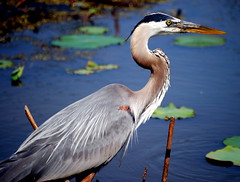
It's hard to get too lost once you're on the island, but here is a map of the trails to help you plan your visit. The island includes areas that are bottomland woods, typical of what you'd see in other parks along the Potomac. More unusual is a tidal freshwater marsh on the interior of the island, along the Swamp Trail. The wetlands include numerous flowers that attract pollinators over the summer, including pickerel weed, hibiscus, cardinal flower, joe pye weed, and ironweed. Some of our notable wildlife sightings here include hummingbirds, great blue herons, and a cuckoo.

From Rosslyn Metro:
  • Take Wilson Blvd. to North Lynn St.
  • Go north (left) on N. Lynn, crossing Lee Highway (which includes two multi-lane sections and a bridge over Rte. 66).
  • Just after you've passed the west-bound section of Lee Highway, take the paved hiker-biker trail going to the right. Follow the trail over a pedestrian bridge over the GW Parkway.
  • Once you're over the Parkway, you'll head south (downstream) along the path, through the parking lot, then take another footbridge across the river to the island.

By this route, it's about .8 mi from Metro to the island. From Georgetown, you can cross the Key Bridge, stay on the left and follow the same path off N. Lynn at Lee Highway.

Dogs: "
Pets are permitted on Theodore Roosevelt Island if they are wearing a leash no longer than 6 feet and the owner is holding the leash at all times."

Bikes: Bikes are a great way to get to Roosevelt Island, but they're not allowed on the island.
Bicycles are allowed on Metro trains all day on weekends, and at non-peak times on weekdays (not 7 a.m. to 10 a.m. or 4 p.m. to 7 p.m.). There's a bike rack by the footbridge.

Tuesday, June 9, 2009

Car-free DC: Kenilworth Gardens

This is the fifth article in a series on hikes in DC that can be reached by public transportation.

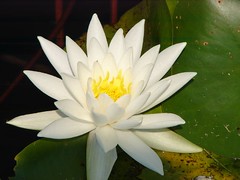
Kenilworth Aquatic Gardens is located across the Anacostia River from the National Arboretum. It was started as a private garden in the 1880's, and was purchased by the Park Service in the 1930's. The park includes both local and imported plants, but features exotic water lilies. Different varieties of lily are in bloom from late May through early September. Morning is the best time to see them; the flowers close when the temperature rises above 89 degrees. In keeping with this, the park has unusual hours: 7 AM to 4 PM.

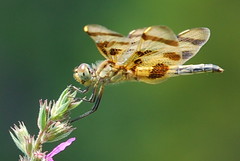
Even if the water lilies are from far away, the wildlife that graces the park are all locals seeking out the wetland habitat. The 14 acres of cultivated gardens are surrounded by 77 acres of marsh, which supports much diversity. In 1992, the Park Service began a major wetlands restoration that planted native plants such as cattail and wild rice along the river. A short boardwalk gives access to this marsh area; there is also a short path along the river. You may see waterfowl, dragonflies, and possibly beavers and muskrats.

The entrance to the Aquatic Gardens is at 1550 Anacostia Avenue between Douglas Street and Quarles Street. To get there by public transportation, take the Orange Line to the Deanwood station. Walking west from the station, use the pedestrian overpass to cross 295 (Kenilworth Avenue), then turn left (west) on Douglass Street and make a right on Anacostia Avenue to reach the gardens. This is a walk of less than a mile. To shorten the walk, take the V7 or V8 bus from the east side of the Deanwood station to the intersection of Kenilworth Avenue and Douglass Street, then walk to Anacostia Avenue.

Other info:

Dogs:
Dogs are allowed in the park, but must remain on leash. Please scoop your poop.

Bikes:
There isn't really space for a good bike ride in this park.

Do you have other tips on Kenilworth Gardens, or experiences to report? Make a comment!

Tuesday, May 26, 2009

Car-free DC: C&O Canal

This is the fourth article in a series on hikes in DC that can be reached by public transportation.

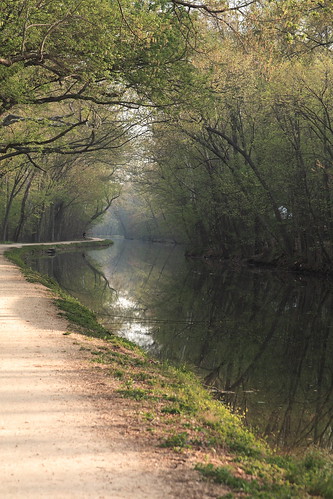
We begin our next installment of car-free hikes in DC just upriver from where the last one left off. The C&O is a 184.5 mile-long canal that was built to transport goods all the way from Georgetown to Cumberland, MD. Many sections are now defunct, but the towpath – and green space on both sides of the canal -- is maintained as a National Park. All that water attracts birds, turtles, and amphibians, and supports lush woods. Many places along the canal also offer access to the Potomac.

Consider how amazing it is that this humongous thing that was built entirely for industry and profit has become such a haven for plants and animals -- and a thing of pure joy for so many people. It's not so often that things go in that direction.

Here are a few easily-reached spots to access the towpath. This map follows the section of the canal that goes through DC from Georgetown to Great Falls.

Georgetown Visitors Center (1057 Thomas Jefferson St.; mile 0). The beginning of the canal can be reached off Thomas Jefferson St., south of M St. in Georgetown. It's about a mile walk from Dupont Circle Metro and a little less from Foggy Bottom. There are also shuttle buses from Dupont, Foggy Bottom, and Rosslyn. At the headquarters here you can pick up park maps and occasionally ride on a barge in the canal, led by an interpreter in period costume. (202-653-5190) This is definitely not the most scenic part of the canal, but it's much quieter than M St.

34th Street (about mile 0.4). The western end of Georgetown is another option for entering the canal. From the south end of 34th St., you'll cross a pedestrian bridge over the canal to reach the path. Turn right, and once you cross under the Key Bridge and the Whitehurst Freeway, you'll be in the woods. You can follow either the paved Capitol Crescent Trail, or the packed dirt towpath. Numerous buses serve M St. from different directions; enter your address with a destination of 3400 M St. NW into WMATA and see what you come up with.

Fletcher's Boat House (4940 Canal Rd; mile 3.1). This concession rents not only boats but also bikes; they also sell bait and tackle. The D3 and D6 buses stop at the intersetion of MacArthur Blvd. and Reservoir Rd., about half a mile away; you can catch one at Dupont Circle or Metro Center.

Capital Crescent Bridge (about mile 3.6). Up until this point, the towpath and the Capital Crescent Trail have been on the same side of the canal (the Potomac side). Near the intersection of Arizona Ave. and Canal Rd., the Capital Crescent Trail crosses back over the canal and goes its own way. You can use this as another access to the towpath. The same D3 & D6 buses that stop near Fletcher's Boat House stop at the intersection of Arizona and MacArthur Blvd. It's about .3 miles to the canal; follow Arizona Ave. south.

That should get you started. Is anyone aware of good car-free access points further out? Leave a comment.

Dogs: "
Dogs are welcome throughout the park, however it is important that they are kept on leashes to ensure the safety and comfort of all of our visitors and to protect the park’s flora and fauna. Dog owners are also expected to collect and remove their pets’ waste."

Bikes:
Absolutely. But the towpath isn't paved, and can be rough in spots; you want something more rugged than a road bike. Bikes can be stashed on the front of any Metrobus; you can take your bike on Metro anytime on the weekend, and anytime except 7-10am and 4-7pm during the week.

Tuesday, May 12, 2009

Car-free DC: Rock Creek Park

This is the second article in a series on hikes in DC that can be reached by public transportation.

Rock Creek Park is a treasure. Especially on the weekend, when Beach drive is closed, it is fairly easy to reach places in the woods where you'd have no idea you were in the city. But most DC residents have barely scratched its surface. And so, we bring you ten points of entry to this 1,754 acre park in the heart of the city. We suggest a couple of our favorite circuit hikes below; you can follow along -- or come up with your own routes -- using this park map.

North to south (downstream):

  1. Boundary Bridge – Riley Spring Bridge loop: The hike that includes these two bridges, using the Valley Trail in one direction and the Western Ridge Trail in the other direction, is one of our favorites. You have two options for accessing this loop by public transit. To come in from the Valley Trail side, take one of the S buses that runs along 16th St. and get off at Juniper St. or Holly St. Alternatively, you can enter from the north: it's about three quarters of a mile from a bus stop on East-West Highway to Boundary Bridge. Take the J2 or J3 buses, which run from Silver Spring Metro to Bethesda Metro and stop at Jones Mill Road/Beach Drive, or Ride On Bus # 1, which runs between Silver Spring and Friendship Heights.
  2. Pinehurst Branch: The Pinehurst Branch is another favorite trail of ours; it follows a tributary of Rock Creek. The S bus Whittier St. stop on 16th St. is the closest we know of. There are several good trails going both south and north from here, leading to possibilities for one-way hikes between Whittier St. and points further north on 16th St., or the Nature Center.
  3. Nature Center: it's not huge, but they've got maps and other info and displays to help orient you to the park. Rangers also lead activities from here, and you can access several trails. The E2/3/4 buses stop at the intersection of Military Rd. and 27th St., on their run between Friendship Heights and Fort Totten.
  4. Soapstone Valley: This area was named "Best Place in Rock Creek Park You’ve Never Been To" in the City Paper's Best of DC 2008. Native Americans quarried several rock deposits in the area for tool supplies. You'll follow a small stream down to where it meets Rock Creek. From Van Ness Metro, you can find trailheads on either Yuma or Albemarle St.
  5. Carter Barron: another stop on the 16th St. S bus. We usually walk down Morrow Dr. to the park police station, where you can pick up the Valley Trail. Be forwarned, though, that there's no walking path on Morrow Dr. – you'll be on the shoulder.
  6. Peirce Mill: This was an 1820s gristmill whose waterwheel ran off Rock Creek. Nearby, the Art Barn is a carriage house that now serves as an art gallery. You can get there via Soapstone Valley, or come in through the Melvin C. Hazen Park, which is between the Van Ness and Cleveland Park Metro stops (enter between Rodman and Sedgwick on the east side of Connecticut Ave.)
  7. Piney Branch Parkway: Matt always wows groups with this route into the park. People can't believe how quickly you can reach tranquility from the bustle of the city. From Columbia Heights Metro, take Irving St. west, then take Mt. Pleasant St. north, jog left on Park Dr., then right again to continue north on Mt. Pleasant. The road dead-ends at a trailhead that will put you onto the trail that follows the Piney Branch Parkway.
  8. The Zoo: As you can see on the map, the National Zoo is not part of Rock Creek Park, but it's nestled right in there. From Woodley Park metro, one option is to go through the zoo and pick up the trail that follows the creek on the backside, near the kids' farm area. Alternatively you can go down the big hill along 24th St. as it heads down into the park. The stretch of park south of here has an exercise circuit with various stations. Note how narrow the park is getting down here – the trails continue along the creek, but you're right next to the Parkway – and unlike Beach Drive, it doesn't close down on weekends.
  9. P Street: Another access point to the stretch of the park south of Woodley Park, an easy walk from the Dupont Circle metro. Make sure you go down on the side of the Parkway that you want to be on, because there's too much traffic to cross easily (or safely). It's still pretty despite the cars, though.
  10. Thompson Boat Center: perched at the confluence of Rock Creek and the Potomac, the last stop in Rock Creek Park gives you a chance to explore in another way. The boat center offers boat rentals and lessons. It's about a half mile from Foggy Bottom Metro: go west on I St., left on New Hampshire, then right on Virginia, where you'll walk past the Watergate and then across the Parkway into the boat center. If the Red Line is more convenient, you can also get off at Farragut North and catch the 80 bus toward the Kennedy Center, getting off at New Hampshire and Virginia.


Other info:

Dogs: Dogs are welcome, but are supposed to be on-leash. And, of course, scoop your poop!

Bikes: Allowed on the trails marked as solid grey lines on the park map. In addition, large sections of Beach Drive are closed to cars on weekends (marked in yellow on the park map). Bikes can be stashed on the front of any Metrobus; you can take your bike on Metro anytime on the weekend, and anytime except 7-10am and 4-7pm during the week.

Do you have other tips on accessing Rock Creek? Have you visited recently? Leave a comment and let us know.

Tuesday, May 5, 2009

Car-free DC: National Arboretum

This article is first in a series on hikes in DC that can be reached by public transportation.

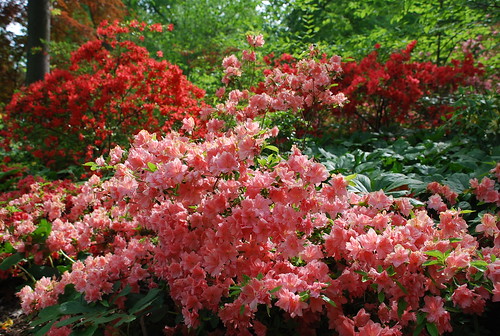
It's azalea time in DC, and nowhere are there more azaleas than at the National Arboretum. Thousands of them, arrayed on a hillside laced with trails for you to explore. What's more, at 240 feet above sea level, "Mount" Hamilton is one of the highest points around, and will reward a small climb with a view of the Capitol.

This year, the arboretum reported the blooms had reached peak on April 30. But there are at least some blooms for weeks on either side of the peak. Follow the azalea "blossom watch" here.

During peak azalea season, there will be crowds. To avoid them, the Arboretum recommends visiting during the week or in the early morning. Crowds also mean lots of cars and parking hassles. This is the perfect situation to inaugurate a series we're calling Car-free DC.

Besides the azaleas, there are lots of good reasons to visit the Arboretum. From the azalea area, you'll see an open field with what looks like the ruins of a Greek temple – it's actually a fun re-purposing of columns that were removed from the Capitol building in a 1958 addition.

Past the columns, you'll come to Fern Valley – the Arboretum's native plant collection and our favorite spot in the park. This is an excellent place to learn the names of plants that you'll see in the woods around DC – many are clearly labeled. Or you can just relax in the shade by the stream and enjoy the lack of azalea-gawkers. There's also a meadow planted with native prairie plants that will show off later in summer – asters, goldenrod, coneflowers, and the butterflies and other pollinators that visit them.

And there's much more: a bonsai collection, a youth garden where local kids have their own plots, a grove consisting of the official trees of every state, waterfront along the Anacostia River…and more. Check out this map of the grounds and this list of what's blooming.

To get to the National Arboretum by public transport:
  • Take Metro to the Stadium Armory Station on the Blue and Orange lines.
  • Take the B2 bus northbound (toward Mount Rainer). If you're unsure where to get off, tell the driver when you board that you want to go to the Arboretum; most drivers will be happy to help you out.
  • You'll get off the bus on Bladensburg Road at Rand Street, just past the Arboretum sign on the right.
  • Walk back to the sign, which is at R Street, and walk down R Street 2 blocks to the Arboretum entrance.

The bus runs every 20 minutes or so on Saturdays and every 25 minutes on Sundays, so you may want to look up when you should leave your local metro station to catch one with a reasonable wait, and take a schedule with you to know when you should aim to catch your ride home. (Of course, that assumes that Metro buses run on schedule, which we know they don't. But still, you can try.)

There's no charge for the Arboretum. The grounds are open 8-5 throughout the year except Christmas Day. The Visitor's Center and bonsai collection are closed for several holidays, and sometimes close early – check the website or give a call.

More info:

Dogs:
"
must be leashed at all times and must be controlled so that they do not urinate on, defecate in, or enter garden beds. Owners must clean up after their pets. Pets are not allowed in the Administration Building or in the National Bonsai and Penjing Museum."

Bikes: There are nine miles worth of roads you can ride on, and the speed limit is 20 mph. There are bike racks at each parking area in the Arboretum.

United States National Arboretum
3501 New York Avenue, NE
Washington, DC 20002-1958
202-245-2726


Bookmark and Share